EU Eastern Dimension
Cosa è successo a Kiev? Nulla di inatteso, purtroppo. Sono stati gli estremisti, rimasti fuori dalla trattativa politica parlamentare, ad aver soffiato sul fuoco della protesta violenta e ad aver provocato gli scontri.
Le opposizioni sono formate da un fronte composito di forze eterogenee, alcune delle quali lontane ideologicamente fra loro.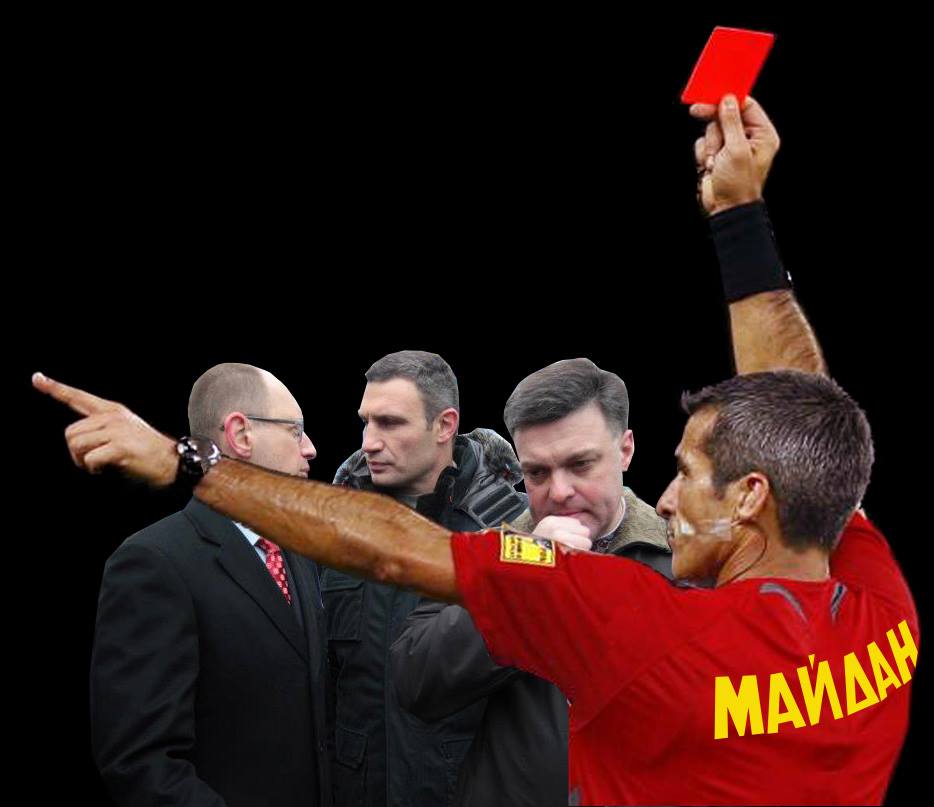
Ufficialmente sono tre i leader politici: Arsenij Jatseniuk del partito “Patria” (quello dell’ex premier Julija Timoshenko), l’ex pugile Vitalij Klitschko capo di Udar, ed Oleg Tjagnibok responsabile dei nazionalisti “Svoboda”.
Sono loro ad avere imbastito il negoziato con il presidente Viktor Janukovich a nome del “Maidan”, che, in realtà, nelle sue prime settimane è stato un movimento spontaneo di protesta popolare della società civile ucraina.
In una seconda fase, col passare dei giorni e l’aumento del numero della barricate, si sono aggiunti i movimenti legati all’estremismo ultranazionalista, come l’ormai famoso “Settore di destra”. Questi radicali, che si vedono come i difensori della nazione ucraina e non lottano affatto per l’integrazione europea come i liberal-riformisti, hanno preso il controllo delle operazioni di “difesa del Maidan”.
La politica li ha esclusi dal tavolo delle trattative, nonostante essi abbiano tentato di avere una loro rappresentanza. Il loro unico obiettivo è la rimozione del presidente Janukovich, non i mutamenti costituzionali. E adesso sarà difficile farli sgombrare dal Maidan.
I radicali extraparlamentari, insieme ai delusi del movimento (che sono tanti!), si sono resi conto che il capo dello Stato tentava di allungare nei tempi il più possibile la partita negoziale alla Rada, per potere arrivare a giocare le sue carte alle prossime presidenziali previste per il marzo 2015, ma ora anticipate di tre mesi.
Le opposizioni sono in minoranza in Parlamento, dove sono troppo spesso apparse non in grado di prendere l’iniziativa. Ecco, quindi, la ragione per la quale i radicali hanno utilizzato la forza e la violenza per provocare concessioni da parte di Janukovich.
Che la situazione politica a Kiev sia estremamente complessa lo dimostra il fatto che la cancelliera tedesca Merkel abbia invitato a Berlino per consultazioni, lunedì 17, i soli Jatseniuk e Klitschko, escludendo Tjagnibok, considerato da fonti polacche troppo vicino a forze vetero-fasciste.
Parallelamente si gioca la partita geostrategica. La Russia ha messo sul tavolo gli aiuti finanziari necessari a salvare l’Ucraina dalla bancarotta. L’Unione europea non intende spendere nemmeno un euro.
Mosca ha già consegnato a Kiev 3 miliardi di dollari. Bruxelles ha solo tentato di scongelare invano presso il Fondo monetario internazionale un vecchio prestito agli ucraini bloccato dal 2011.
I catastrofici errori della diplomazia continentale sono sotto gli occhi di tutti e rischiano di spaccare in due l’ex repubblica sovietica. In questi giorni il suo destino come Stato unitario, uscito dal crollo dell’Unione Sovietica nel 1991, è fortemente messo in dubbio.
gda
ЕС с Россией вместе.
1 Jan 2014«В России радуются геополитической победе над Европой. Малая Русь спасена от европейского разврата и эксплуатации. О боже, ведь Украина еще до подписания соглашения об ассоциации с ЕС должна была внести изменения в ряд законов и даже Конституцию страны, но снова мешки с баблом задушили демократические права, на соблюдении которых настаивал Европейский союз!…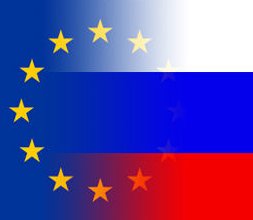
Да, Украина остается частью постсоветского мира, которым с помощью кнута и пряника хочет править Россия. Но все же это временная победа. Украина, как и другие государства, которые образовались после развала Советского Союза, в любом случае будет стремиться к тесному сотрудничеству с Европой, несмотря на то что сегодня их лидеры неприкрыто льстят Кремлю. Более того, курс на сближение с Евросоюзом ждет и саму Россию… » ***
Статья – Иржи Юст – Московский Комсомолец № 26417 от 23 декабря 2013 г. Jiří Just Moskovskij Komsomolets.
Eastern Partnership, as one of the priorities of the Lithuanian Presidency of the Council of the EU, is a natural choice, determined by the Lithuanian and the EU interest to have safe, stable, economically strong and pro-European Eastern neighbours. Our goal is to have pro-active and efficient Eastern Partnership policy that would bring tangible results for these countries and their people. This could be achieved through the joint efforts of the EU institutions, EU Member States and Eastern Partners themselves. 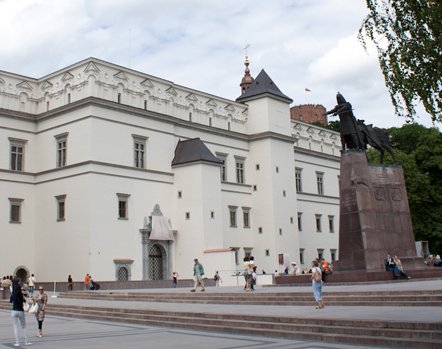
Through the Eastern Partnership, the EU strengthens its bilateral and multilateral cooperation with the six Eastern European partners: Armenia, Azerbaijan, Belarus, Georgia, Moldova and Ukraine, supports reform processes of these countries, and seeks to bring them closer to the EU.
Main results
Over the first four years of its implementation, Eastern Partnership initiative has brought a number of tangible results:
- Association Agreements, including Deep and Comprehensive Free Trade Areas, as their integral parts, have been negotiated with Ukraine, the Republic of Moldova, Georgia and Armenia; good progress has also been achieved in respective negotiations with Azerbaijan;
- considerable progress has been made in the area of visa facilitation and liberalization: 5 out of 6 partners already have or will soon have Visa Facilitation Agreements; 3 of them managed to advance even more – they now have Visa Liberalization Actions Plans, prepared specifically to them, full and effective implementation of which will bring these countries straight to the visa free travels with the EU;
- the multilateral cooperation dimension has been established and further strengthened: it now includes senior officials and experts working in a number of different areas, from agriculture and environment to trade, migration and CSDP;
- sectorial cooperation has also been enhanced, with the first Eastern partnership ministerial meetings in the fields of Justice and Home Affairs, and Transport, held in October 2013, in Luxembourg;
- cooperation between societies at large has been started and such formats as Civil Society Forum, Conference of the Regional and Local Authorities (CORLEAP), Business Forum and Youth Forum are now meeting on a regular basis, thus contributing to the monitoring of the implementation of the Eastern Partnership, but also to the policy shaping.
The third Eastern Partnership Summit in Vilnius
The third Eastern Partnership Summit in Vilnius will be held on the 28-29 November, 2013. The leaders and other high level representatives of the EU institutions, 28 EU Member States and the 6 Eastern European Partner States are expected to take part in the EaP Vilnius Summit. The event will be hosted by the President of the Republic of Lithuania Dalia Grybauskaitė and chaired by the President of the European Council Herman Van Rompuy.
Eastern Partnership Summits are held every two years (the first two Summits took place in the Czech Republic (Prague), 7 May, 2009, and in Poland (Warsaw), 29-30 September, 2011). During these meetings, the implementation and the results of the Eastern Partnership are discussed, the objectives for the next two years are determined and the prospects for the future are drawn.
Source: official site of the Summit
* * *
Joint statement by President of the European Council Herman Van Rompuy and President of the European Commission José Manuel Barroso on Ukraine
Concerning the Ukrainian decision to suspend temporarily the preparations for signing the Association Agreement and Deep and Comprehensive Free Trade Area (DCFTA), the European Union’s position remains clear. The offer of signing an unprecedented Association Agreement and a DCFTA is still on the table. This requires the necessary political will by the Ukrainian leadership, determined action and tangible progress on the conditions set out in December 2012.
Important progress has already been achieved by Ukraine. We are convinced that signing the Association Agreement and a DCFTA, the most ambitious agreement the European Union has ever offered, provides the best possible support for Ukraine’s economic situation, reform course and modernisation in view of building a prosperous and stable future for all Ukrainians. The EU stands ready to be more open and more supportive to those who are willing to engage in reforms and modernisation.
While being aware of the external pressure that Ukraine is experiencing, we believe that short term considerations should not override the long term benefits that this partnership would bring. However the European Union will not force Ukraine, or any other partner, to choose between the European Union or any other regional entity. It is up to Ukraine to freely decide what kind of engagement they seek with the European Union. Ukrainian citizens have again shown these last days that they fully understand and embrace the historic nature of the European association.
We therefore strongly disapprove of the Russian position and actions in this respect. The Association Agreement and a DCFTA are opportunities to accompany our common neighbours towards modern, prosperous and rule-based democracies. Stronger relations with the European Union do not come at the expense of relations between our Eastern partners and their other neighbours, such as Russia. The Eastern Partnership is conceived as a win-win where we all stand to gain. The European Union continues to stand ready to clarify to the Russian Federation the mutual beneficial impact of increased trade and exchanges with our neighbours, whilst fully respecting the sovereignty and independence of our Eastern Partners and the bilateral nature of Association Agreement and DCFTAs.
The European Union looks forward to the Eastern Partnership Summit in Vilnius this week. It will be an important moment to take stock of the situation and take forward the relations with our Eastern partners.
La battaglia è probabilmente finita. L’ultima incognita è legata alla tradizionale imprevedibilità degli ucraini. Ma se dovesse andare proprio in questo modo il processo di integrazione europea ad Est, nelle terre un tempo ex sovietiche, segnerebbe una brusca frenata.
Le pressioni del Cremlino sulla repubblica ex sorella hanno avuto, pertanto per ora, la meglio. Nei mesi scorsi la Russia ha iniziato a far capire a quali conseguenze spaventose l’Ucraina sarebbe andata incontro se Kiev avesse legato il suo destino all’Ue.
Mosca non intende avere concorrenti all’interno del suo “cortile di casa” è la lezione appresa in questi giorni tesissimi dai funzionari europei.
A nulla è valsa la dichiarazione al vetriolo della cancelliera tedesca Merkel, che ha ricordato a Vladimir Putin, che la “Guerra Fredda è finita da 24 anni” e che ogni Paese è sovrano di decidere la sua politica.
Il presidente Janukovich è stato posto davanti alla scelta tra il Patto Associativo con l’Ue e la concorrente nascente Unione Doganale, una specie di Urss economica. Il primo è un ottimo investimento sul futuro con vantaggi enormi nel lungo periodo. La seconda è un rattoppo utile nel breve periodo, ma un progetto troppo ambizioso che zoppica fin dai suoi esordi.
In sintesi, Kiev è rimasta stritolata in mezzo.
Dopo il voto negativo del Parlamento ucraino l’Unione europea lascia ancora la porta aperta, anche perché è finalmente conscia che Janukovich e i suoi si trovano davanti ad una decisione epocale, non solo economica ma anche geostrategica e psicologica.
Gli europei, per decenni satelliti del Cremlino, sanno perfettamente che la Russia senza l’Ucraina non potrebbe più essere in futuro un impero e verrebbe ricacciata ad Est, verso l’Asia. A Kiev è poi nata la Rus’ medioevale e da quelle radici storico-culturali-religiosi si è sviluppata successivamente la Moscovia.
Chi vincerà questo scontro geopolitico tra Russia ed Ue dovrà, comunque, farsi carico dell’Ucraina, Paese oggi sull’orlo di una gravissima crisi finanziaria. Nei prossimi mesi serviranno non meno di 10 miliardi di dollari per rimpinguare le asfittiche casse di Kiev.
Altrimenti l’intera Europa centrale sarà colpita da una nuova ondata di crisi.
gda
A dieci anni dalla “Rivoluzione delle rose” la Georgia volta pagina: finisce l’era Saakashvili. Il Paese caucasico diventa contemporaneamente una repubblica parlamentare per l’entrata in vigore della riforma costituzionale del 2010. 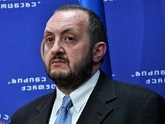
23 erano i candidati in lizza, ma di questi soltanto tre avevano vere chance. Ossia il filosofo 44enne Georgy Margvelashvili (rappresentante della coalizione Sogno georgiano ora al potere), l’ex speaker del Parlamento Nino Burjanadze (la “dama di ferro” della Rivoluzione delle rose del 2003 poi avversaria del capo di Stato uscente), il 41enne diplomatico David Bakradze (membro del Movimento Unito Nazionale di Saakashvili).
Ha vinto Margvelashvili con oltre il 62% delle preferenze, secondo è arrivato Bakradze con il 21, quindi la Burjanadze con un po’ più del 9% dei voti.
In campagna elettorale tutti i principali candidati avevano ribadito il corso di integrazione europea e nelle strutture dell’Alleanza atlantica intrapreso dal Paese caucasico, che, nell’agosto 2008, ha combattuto una disastrosa guerra contro la Russia in Ossezia meridionale.
“Maggioranza ed opposizione – ha sottolineato Margvelashvili – sono d’accordo sulla direzione fondamentale del nostro sviluppo e sugli obiettivi della nostra politica esterna nazionale”.
Il che potrebbe significare la firma del Patto di Associazione con l’Unione europea già il prossimo 28 novembre a Vilnius.
La Burjanadze è stata l’unica a mostrarsi più dubbiosa sull’integrazione nella Nato. “Fino a che vi saranno truppe russe sul nostro territorio – ha evidenziato l’ex speaker del Parlamento – ci sono poche possibilità di aderire all’Alleanza. Non ci sono stati passi politici effettivi per negoziare con Mosca”.
La Georgia è però un crocevia strategico fondamentale tra il mar Caspio ed i ricchi mercati occidentali. Da qui passano le principali pipeline tra Asia ed Europa. Ecco spiegata la grande attenzione prestata dalla comunità internazionale a queste elezioni.
Avendo già svolto due mandati presidenziali, il giovane carismatico leader georgiano, Michail Saakashvili, non ha potuto partecipare alla consultazione.
Con lui uscirà dalla vita politica attiva anche il suo principale avversario, l’attuale premier Bidzina Ivanishvili, che ha già annunciato le dimissioni per aver raggiunto i suoi obiettivi. Questo miliardario è infatti sceso in politica solo per dare al suo Paese un’alternativa al controverso Saakashvili, che ha dominato la scena nazionale dal 2003 con la Rivoluzione delle Rose, con cui di fatto spodestò dalla presidenza Eduard Shevardnadze, l’ex ministro degli Esteri di Gorbaciov.
Lo scorso anno ad ottobre il suo partito Sogno georgiano ha nettamente vinto le parlamentari, sconfiggendo duramente il movimento di Saakashvili.
“Per la prima volta – ha detto al suo seggio Ivanishvili – un candidato della compagine al potere non usa risorse amministrative per la sua campagna elettorale. Queste sono le prime elezioni di stampo europeo”.
Dopo l’uscita dei due grandi avversari la Georgia comunque cambierà. Entrerà in vigore la riforma costituzionale che la fa diventare una repubblica parlamentare. Il presidente rimarrà formalmente il capo dello Stato, manterrà ampio spazio decisionale nella politica estera, ma il governo ed il primo ministro acquisiranno maggiori poteri rispetto al passato.
Today we attended the Wilton Park conference, The Eastern Partnership: moving ahead, which included participants from across the EU and from Eastern Partner countries. The Eastern Partnership, with its focus on the future prosperity of Eastern Europe, is at the top of our agendas. Today’s discussion helped shape that future direction. 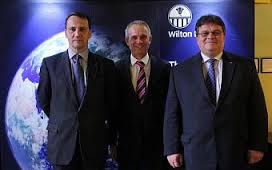
On the 28-29 November, Lithuania will host the third Eastern Partnership Summit in Vilnius. This will be an important moment for the EU and Eastern Europe. The possibility of Ukraine signing its Association Agreement, including a Deep and Comprehensive Free Trade Area, and Moldova and Georgia initialing agreements, will be important milestones towards redefining and strengthening the EU’s relationship with our Eastern European partners.
Eastern partners have already made significant irreversible and sustainable political and economic reforms, which will benefit their citizens. As they continue to grow they need to continue to implement further reforms. Liberalised economies, open and inclusive politics, and respect for the rule of law are all key building blocks for prosperity in the EU from which our eastern partners and others can benefit. We are ready to support partner countries in their efforts to implement reforms and the Association Agreements.
As we look towards the future we hope to see an Eastern Partnership that supports those seeking an ever closer relationship with the EU, and for some eventual EU membership, that supports open economic polices, inclusive democracy and that sustains respect for the rule of law, and we will do all that we can to ensure it.
Linas Linkevičius, Minister of Foreign Affairs of the Republic of Lithuania
Radosław Sikorski, Minister of Foreign Affairs of the Republic of Poland
David Lidington, Minister of State, Foreign and Commonwealth Office, United Kingdom
London – 14 October 2013
“As you know, the Kaliningrad region is isolated, geographically isolated, so we could apply some measures also to cut something,” said Linas Linkevicius, Lithuanian Foreign Minister. “Transport, we could cut off trains, but not only trains, also the supply of goods, whatever. It is theoretically possible,” the official added. 
Journalists raised the topic as Lithuania, which currently holds the rotating presidency in the EU, is preparing to host the Third Eastern Partnership Summit– the major conference dedicated to strengthening trade ties between the European economic bloc and six states in Eastern Europe and the Caucasus – Armenia, Azerbaijan, Belarus, Georgia, Moldova and Ukraine. All of these countries are Russian neighbors and close economic partners.
Russia is currently building its own economic bloc – the Customs Union – which currently consists of itself, Belarus and Kazakhstan, but to which it welcomes other neighboring nations.
Brussels is locked in an increasingly tense standoff with Moscow over its Eastern Partnership policy, which is designed to draw six countries — Ukraine, Belarus, Moldova, Georgia, Azerbaijan and Armenia — more closely into the European fold.
At the Vilnius summit on Nov. 28 to 29, the EU is expected to sign a free trade deal with Ukraine and take further steps towards free trade agreements with Moldova and Georgia. No substantial progress is expected with the other partnership states, which remain more closely aligned with the Kremlin.
The Cabinet of Ministers approved the draft Association Agreement between Ukraine and the European Union and its member states.
“It just became known that the government had approved the draft Association Agreement with the EU,” a government spokesman told journalists in Kyiv. The government published the draft agreement on the Web site of the Cabinet of Ministers in August 2013. 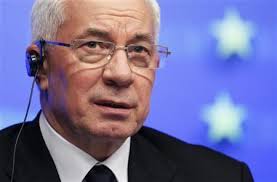
The 236-page document comprises of seven sections and 486 articles, some of which deal with the media activities, protection of personal data, protection of intellectual property, and other issues.
According to the draft agreement, the aims of association are to promote a gradual rapprochement between the parties based on common values and close and privileged links, and increasing Ukraine’s association with EU policies, and participation in programs and agencies, establish conditions for enhanced economic and trade relations leading towards Ukraine’s gradual integration in the EU internal market including by setting up a Deep and Comprehensive Free Trade Area, as well as to enhance cooperation in the field of justice, freedom and security with the aim of reinforcing the rule of law and the respect for human rights and fundamental freedoms.
Ukraine and the EU started negotiations on new agreement in 2007. The parties initialled an Agreement on association and profound and overall free trade area on March 30, 2012.
Ukrainian Prime Minister Mykola Azarov said the agreements, which should be signed at a November summit in Lithuania, raised the prospect of “a European quality of life” for the ex-Soviet republic.
“We believe we must make every effort for Yulia Tymoshenko to be freed before the Vilnius summit,” Iryna Gerashchenko, a deputy for the opposition party UDAR, told Interfax-Ukraine.
“Even though the signing is important to the EU and Ukraine, the EU will never be able to close its eyes to the violation of fundamental values such as human rights, including the right of defense in a court and the right to justice,” she said.
From Unian and Interfax-Ukraine
“On July 1st Croatia become the 28th member of the European Union. The lights of the welcome party have yet to be switched off and the hangover of reality is already setting in. Joining the EU is not the solution to Zagreb’s daily problems.
What a difference from the 2004 enlargement! At that time 10 states joined the European Union not only to create one of the largest areas of democracy and rule of law in the world but also because Europe wished to be closer to Yalta’s post World War II scenario…
Article – Giuseppe D’Amato – Kyiv Post – July 3, 2013.
Today we held our 30th EU-Russia Summit. This is a real tribute to the important nature of our partnership. It demonstrates the priority which we attach to this strategic relationship. Russia and the EU have a lot to gain from cooperating.
Our economies are strongly linked:
45 % of Russia’s exports go to the EU, while 35 % of Russia’s imports come from the EU.
We are neighbours on our continent. More than 5 million Schengen visas were issued in 2011 in Russia. We may have different positions in some areas but we have more common interests. We must work together to guarantee security and stability on the European continent, to tackle global challenges and governance issues, and to promote economic growth. 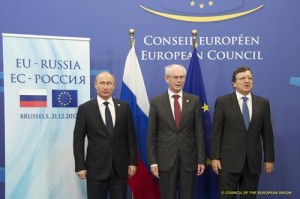
We have had a positive and constructive working summit. It provided us with an important occasion to take stock of main developments and to review progress and challenges across the wide range of EU-Russia relations. We also discussed how we can deepen our cooperation and implement already agreed commitments.
Our Partnership for Modernisation works. We have taken note of the latest Progress Report, and welcome the good results achieved in many areas. Further progress has to be made in the negotiations towards a New Agreement, which can put our future relations on a solid legal basis. The EU is very eager to progress faster in these negotiations.
We have discussed domestic economic developments in Russia and the EU. I explained the decisions of last week’s European Council regarding the strengthening of the EMU and the huge progress we made in stabilising the euro zone.
The EU is deeply convinced that we need to create space for civil society activities in order to achieve an effective modernisation of the economy and of the society.
We have noted the outcome of our latest Human Rights Consultations on 7 December which provided a useful occasion to discuss our concerns on the freedom for civil society activities and the exercise of fundamental rights in Russia. I mentioned also other concerns, including the case of Sergey Magnitsky.
As regards foreign policy, we have discussed ways to deepen our political cooperation at global level. We already work well together on issues like the Middle East Peace Process, Afghanistan or Iran. We have to continue our efforts to find a peaceful political solution on Syria in full support of Mr Brahimi’s efforts.
Russia and the EU work closely together in the Quartet, and we remain committed to a two-state solution to the Israeli-Palestinian conflict. In this respect I would like to highlight the joint statement by Foreign Minister Lavrov and High Representative Ashton today on the Middle East Peace Process.
As regards our Common Neighbourhood, I highlighted the need to achieve stability and security as well as democracy and a market-oriented economy. This is the aim of EU’s support within the Eastern Partnership Programme, especially as regards to Ukraine, Moldova and Georgia.
We welcome that the elections in Georgia open up new opportunities to improve bilateral relations and work towards stability in the Southern Caucasus, on the basis of the respect for territorial integrity.
It is particularly important to address the protracted conflicts. I also raised the importance of moving forward in the ‘5+2’ talks on the conflict in Transnistria and expressed concerns regarding developments in Nagorno-Karabakh.
By working together, the EU and Russia can make a decisive contribution to global governance and regional conflict resolution, to global economic governance in the G 8 and G 20, and to a broad range of international and regional issues. I would like to congratulate President Putin for taking over the presidency of G 20.
I am pleased that President Putin and the EU have discussed all these issues openly in a very constructive atmosphere. I want to thank the President of the Russian Federation for the constructive and productive exchange.
Press statement
by the President of the European Council
Herman Van Rompuy
following the 30th EU-Russia Summit.
Brussels, 21 December 2012
EUCO 243/12
PRESSE 557
PR PCE 206
Welcome
We are a group of long experienced European journalists and intellectuals interested in international politics and culture. We would like to exchange our opinion on new Europe and Russia.
Categories
- Breaking News (11)
- CIS (129)
- Climate (2)
- Energy&Economy (115)
- EU Eastern Dimension (85)
- Euro 2012 – Sochi 2014 – World Cup 2018, Sport (43)
- Euro-Integration (135)
- History Culture (198)
- International Policy (261)
- Military (74)
- Interviews (18)
- Italy – Italia – Suisse (47)
- Odd Enough (10)
- Poland and Baltic States (126)
- Religion (31)
- Russia (421)
- Survey (4)
- Turning points (4)
- Ukraine (176)
- Российские страницы (113)
Archives
- November 2020
- October 2020
- September 2020
- August 2020
- July 2020
- May 2020
- April 2020
- March 2020
- January 2020
- December 2019
- November 2019
- October 2019
- September 2019
- August 2019
- July 2019
- June 2019
- May 2019
- April 2019
- March 2019
- February 2019
- December 2018
- November 2018
- October 2018
- September 2018
- August 2018
- July 2018
- June 2018
- May 2018
- April 2018
- March 2018
- February 2018
- January 2018
- December 2017
- November 2017
- October 2017
- September 2017
- August 2017
- July 2017
- May 2017
- March 2017
- January 2017
- December 2016
- November 2016
- October 2016
- September 2016
- July 2016
- June 2016
- May 2016
- April 2016
- February 2016
- January 2016
- November 2015
- October 2015
- September 2015
- June 2015
- April 2015
- March 2015
- February 2015
- January 2015
- December 2014
- November 2014
- October 2014
- September 2014
- August 2014
- July 2014
- June 2014
- May 2014
- April 2014
- March 2014
- February 2014
- January 2014
- December 2013
- November 2013
- October 2013
- September 2013
- August 2013
- July 2013
- June 2013
- May 2013
- April 2013
- March 2013
- February 2013
- January 2013
- December 2012
- November 2012
- October 2012
- September 2012
- August 2012
- July 2012
- June 2012
- May 2012
- April 2012
- March 2012
- February 2012
- January 2012
- December 2011
- November 2011
- October 2011
- September 2011
- August 2011
- July 2011
- June 2011
- May 2011
- April 2011
- March 2011
- February 2011
- January 2011
- December 2010
- November 2010
- October 2010
- September 2010
- August 2010
- July 2010
- June 2010
- May 2010
- April 2010
- March 2010
- February 2010
- January 2010
- December 2009
- November 2009
- October 2009
- September 2009
- August 2009
Our books