All English posts
Je suis Charlie!
8 Jan 2015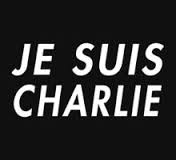
EuroLithuania!
1 Jan 2015Lithuania is the 19th European state to adopt the continental currency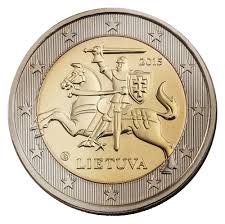 .
.
The euro gives the country more freedom in negotiating business with Russia, said Valdas Adamkus, who was president of Lithuania for about a decade until 2009. It provides an extra measure of geopolitical security.
At 0.4 percent, its inflation rate is just a hair above the euro zone average of 0.3 percent, and its 9.5 percent unemployment rate is right in the middle of the pack, and comfortably below the zone average of 11.5 percent. Lithuania’s 1.3 percent real GDP growth rate beats both of its Baltic partners and is again well above the -2.2 percent Euro Zone average.
New sanctions against Russia and Crimea.
22 Dec 2014 The European Union and United States adopted tighter restrictions on investments in Crimea, targeting individuals, Russian Black Sea oil and gas exploration and tourism.
President Barack Obama said he had signed into law a new Russian sanctions bill passed by Congress, but added that he did not intend to impose further curbs against Moscow for now. However, Canada announced on Friday 19th that it was hitting Russia with a fresh round of restrictions.
Russian Foreign Ministry spokesman Alexander Lukashevich said the sanctions undermined political efforts to resolve the conflict in eastern Ukraine, adding that Crimea was a “primordial and inseparable” part of Russia.
EU investment ban, the latest in a series of measures since July, is also designed to show that despite a dive in the Russian rouble’s value, there will be no lifting of sanctions unless Moscow drops its support for rebels in eastern Ukraine.
Obama, “Putin is not a chess master” player.
22 Dec 2014 Mr. Putin is not “the chess master and outmaneuvering the West and outmaneuvering Mr Obama and this and that and the other.”
Instead, Putin’s policies and the stringent economic sanctions they had prompted against Russia by the West had led to a “huge economic contraction” Obama said in an interview.
“Right now, he’s presiding over the collapse of his currency, a major financial crisis and a huge economic contraction,” Obama told CNN‘s “State of the Union” program.
“That doesn’t sound like somebody who has rolled me or the United States of America.”
Donald Tusk, New EU President.
1 Dec 2014 Today is my first day in office as President of the European Council. As you can imagine it is a very important day for me. And I hope that it is for you as well. If you are a little nervous about this replacement, the change of boss, don’t worry, I’m a little nervous, too. In fact it is a great honour for me to start working here. And of course a great challenge. 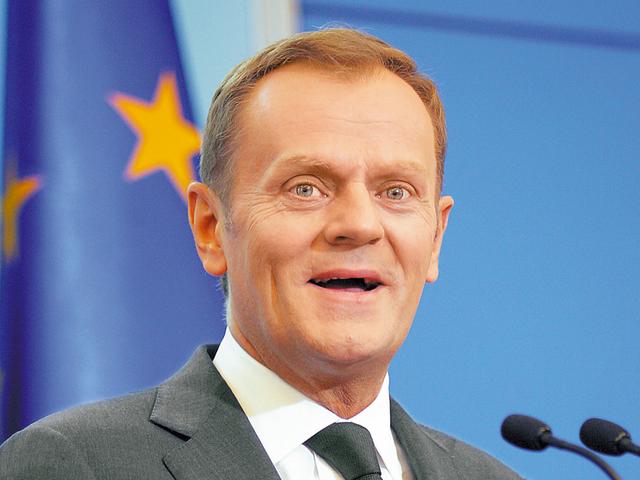 First and foremost because Herman Van Rompuy, our first permanent President, will be a tough act to And it is not a compliment, dear Herman, it is a fact. I am perhaps your greatest admirer in Europe. Not because you supported my election as your successor… or at least not only. It is no exaggeration when I say that you helped to steer us, to steer Europe out of the storm.
For five years – as one of the Prime Ministers around the table – I witnessed your skills: creating compromises; finding solutions; establishing trust, among often tough characters (I was no angel myself). Yes: Herman Van Rompuy in fact personifies traditional European political principles, which are also important to me: trust, common sense, moderation and decency. We all thank you for the excellent work you have done, Herman.
Dear colleagues, mes chers collègues, I also thank you for the great job you have done. I am aware of the importance of your work of protocol, of press, of interpretation, of translation, of security, of political advice, and all the other tasks and roles of this house. You were all an important part of Herman Van Rompuy’s success. And I d eeply believe that you will all be an important part of our future success. I come here with a strong sense of purpose. In these difficult times Europe needs success. And success for Europe, in the coming years, means in my opinion four things:
First, protecting our fundamental values: solidarity, freedom, unity against the threats to the Union and its unity coming from both inside and outside. Today, not only are eurosceptics questioning the EU’s value, the Union even has enemies. Politics has returned to Europe, history is back, and such times need leadership and political unity.
Second, we need ruthless determination to end the economic crisis. It is our responsibility to complete the genuine Economic Monetary Union. I take this task very seriously. And we must remember that our common currency, the Euro, is our advantage, not our disadvantage.
Third, the European Union must be strong internationally. Europe has to secure its borders and support those in the neighbourhood who share our values.
And fourth, the relations between Europe and the United States are the backbone of the community of democracies. Both we and the Americans are responsible for the future of our relations. The year ahead will be crucial. For all of these things, I will need your help at every step of the way. I already know a lot about your dedication, your determination, your expertise. That gives me great confidence. Confidence that we will work as a team.
Je me réjouis à l’idée de travailler avec vous. (That was French.)
Merci Dank u wel, Herman. Thank you. Dziękuję bardzo, Polsko.
Calling Pope Francis his “beloved brother in Christ,” the head of the Orthodox Church, Ecumenical Patriarch Bartholomew I on Sunday recalled their gathering last May at the Church of the Holy Sepulcher in Jerusalem on the fiftieth anniversary of the historic ecumenical meeting of their predecessors, Pope Paul VI and Patriarch Athenagoras. 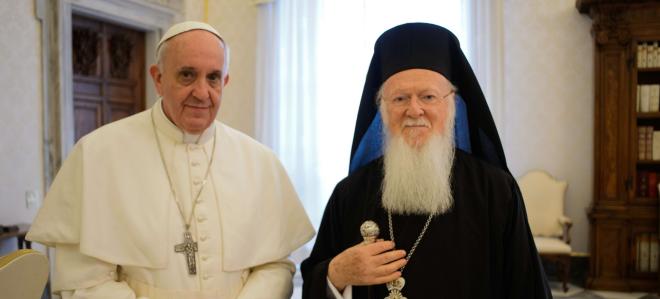
Welcoming the Pope after a celebration of the Divine Liturgy at the Patriarchal Church of St. George in Istanbul, Patriarch Bartholomew said “the path toward unity is more urgent than ever for those who invoke the name of the great Peacemaker.”
Citing the “diverse divisions, conflicts and animosities, frequently even in the name of God,” the Patriarch said Christians have a “great” responsibility “before God, humankind and history.”
He noted that the Orthodox Church is preparing for its Great Council planned for 2016 and asked Pope Francis to pray for its success. The Patriarch expressed satisfaction that members of both Churches are present as observers in each other’s synodal life and said he hoped that once full communion is restored, “the significant and special day” of holding a joint Great Ecumenical Council will “not be prolonged.”
In concluding, the Patriarch said “the challenges presented to our Churches by today’s historical circumstances oblige us to transcend our introversion in order to meet them with the greatest degree of collaboration. We no longer have the luxury of isolated action. The modern persecutors of Christians do not ask which Church their victims belong to. The unity that concerns us is regrettably already occurring in certain regions of the world through the blood of martyrdom.”
Vatican Radio – The complete text of Ecumenical Patriarch Bartholomew I’s address to Pope Francis.
Vatican Radio – Dichiarazione congiunta. Papa e Bartolomeo: no a Medio Oriente senza cristiani
Ukraine, The first session of the new Rada.
27 Nov 2014Ukraine’s eighth parliament has started work. A total of 419 new lawmakers were sworn in, including former pilot Nadiya Savchenko, who remains imprisoned in Russia. Oleksandr Turchynov, the speaker of the previous Verkhovna Rada conducted the first session.
27 seats remain vacant in the 450-seat session hall. The annexation of Crimea and Russia’s war against eastern Ukraine prevented deputies from being elected in those parts of the country that are no longer controlled by the authorities.
The Rada approved Arseny Yatseniuk for a new term as prime minister. Five parties have declared their intention to enter a coalition, which will then be responsible for appointing the prime minister, followed by the government.
President Petro Poronshenko, declared that there could be no future formula for Ukraine other than that of a single, unified state. 100 percent of Ukrainians favoured a unitary state without federalisation. “These are our warm wishes to those in the East or West who advise federalisation,” added Ukrainian chief of State, who advice people “to sleep with a revolver under the pillow.”
Farewell to the legendary Viktor Tikhonov.
24 Nov 2014 Russian ice hockey coach Viktor Tikhonov has died at the age of 84. 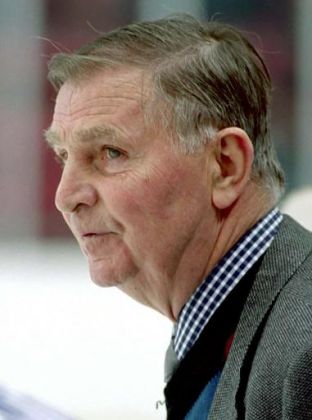
Tikhonov coached the Soviet Union to gold at the 1984, 1988 and 1992 Winter Olympics and passed away after a long-term illness. He is also remembered as the coach of the USSR team that lost the ‘miracle on ice‘ game against the United States in the semi-finals of the 1980 Games. Tikhonov guided the Soviet Union to eight world championships between 1978 and 1990.
As a player, Tikhonov won four Soviet titles between 1951-54 and guided CSKA Moscow to 13 consecutive Soviet titles between 1977 and 1989.
“The entire global hockey community has lost a great coach,” Vladislav Tretiak, who played goalie for Tikhonov’s Soviet team and now heads the Russian Hockey Federation, told Russia’s R-Sport news agency. Tikhonov’s funeral will take place on Thursday with a memorial service at CSKA Moscow, Russian media reported.
G20 leaders’ Brisbane pledges.
16 Nov 2014Raising global growth ‘highest priority’
The communique confirmed G20 members have committed to lifting economic output to deliver an additional 2.1 per cent growth boost by 2018.
“Raising global growth to deliver better living standards and quality jobs for people across the world is our highest priority,” they said.
The target will add more than US $ 1.89 trillion to the global economy and create millions of jobs.
“We will monitor and hold each other to account for implementing our commitments,” they said.
At the same time, the G20 would be mindful of the spill-over effects of this growth on the global economy, including possible inflationary pressures.
This might require central bank actions on monetary policy.
“We stand ready to use all policy levers to underpin confidence and the recovery,” the G20 said.
Progress would be evaluated at next year’s summit in Turkey. 
G20 committed to reducing gap in female employment
The G20 also appears to have heeded a United Nations call to deliver “quality” jobs and support women and jobless youth into work.
“We agree to the goal of reducing the gap in participation rates between men and women in our countries by 25 per cent by 2025,” it said.
This would bring more than 100 million women into the labour force.
A separate plan will encourage education and training for young people, with labour ministers due to report back to the G20 next year.
Focus on international trade
The G20 called for countries support international trade by lowering costs, streamlining customs procedures, reducing regulatory burdens and strengthening trade-enabling services.
“We are promoting competition, entrepreneurship and innovation, including by lowering barriers to new business entrants and investment,” they said.
There were also commitments to eradicate poverty and ensure the G20 contributed to inclusive and sustainable growth in poor and developing countries.
Another key area was taxation, with the G20 endorsing actions to close profit-shifting loopholes for big or multinational corporations and secure country tax revenue bases.
“Profits should be taxed where economic activities deriving the profits are performed and where value is created,” they said.
Concerns surrounding Ebola
The G20 stressed its concerns about the spread of the deadly Ebola virus in West Africa and the human and economic impact.
“We support the urgent co-ordinated international response and have committed to do all we can to contain and respond to this crisis,” they said.
“We call on international financial institutions to assist affected countries in dealing with the economic impacts of this and other humanitarian crises, including in the Middle East.”
G20 nations have backed strong action on climate change in the wake of the Brisbane leaders’ summit.
Climate change
“We support strong and effective action to address climate change,” the official communique released on Sunday said.
Climate change wasn’t on the formal agenda prepared by the Australian presidency, but supportive statements by US President Barack Obama this weekend ensured its inclusion in the final statement.
The leaders agreed their future actions will support sustainable development, economic growth and certainty for business and investment.
The G20 will work together to adopt a protocol under the United Nations Framework Convention on Climate Change to present at the Paris climate conference in 2015.
“We encourage parties that are ready to communicate their intended nationally determined contributions well in advance,” they said.
“We reaffirm our support for mobilising finance for adaptation and mitigation, such as the Green Climate Fund.”
The UN-backed fund was set up to help poor countries deal with the impacts of climate change, such as rising sea levels and severe weather events.
The US this weekend committed $US3 billion to the fund, and Japan $US1.5 billion.
Other commitments or policy actions included:
- strengthening the resilience of the global economy to future shocks
- increasing the stability of the international financial system
- recovering the proceeds of corruption and the denial of safe haven to corrupt officials
- a stronger multilateral trading system under WTO rules, getting Doha trade talks back on track
- improved functioning and stability of energy markets, such as oil and gas, to support energy security
Donetsk
Alexander Zakharchenko, the self-declared prime minister in Donetsk, had won the poll to become the head of the region. His party also came first in the parliamentary election.
Presidency
| Alexander Zakharchenko | 77.51% | 765,340 |
| AlexanderKofman | 10.03% | 111,024 |
| Yuri Sivokonenko | 8.21% | 93,280 |
| Irregular votes | 4.25% |
Turn-out: more than 2 million.
Soviet
| Donetskya Respublika | 64.43% | |
| Free Donbass | 27.75% | |
DNR Electoral Committee
Luhansk
Presidency
| Igor Plotnitsky | 63.08% |
| Oleg Akimov | 15.12% |
| Viktor Penner | 10.08% |
| Larisa Ayrapetyan | 7.28% |
Soviet
| World Luhansk | 69.42% |
| People Union | 22.23% |
LNR: Electoral Committee
Welcome
We are a group of long experienced European journalists and intellectuals interested in international politics and culture. We would like to exchange our opinion on new Europe and Russia.
Categories
- Breaking News (11)
- CIS (129)
- Climate (2)
- Energy&Economy (115)
- EU Eastern Dimension (85)
- Euro 2012 – Sochi 2014 – World Cup 2018, Sport (43)
- Euro-Integration (135)
- History Culture (198)
- International Policy (261)
- Military (74)
- Interviews (18)
- Italy – Italia – Suisse (47)
- Odd Enough (10)
- Poland and Baltic States (126)
- Religion (31)
- Russia (421)
- Survey (4)
- Turning points (4)
- Ukraine (176)
- Российские страницы (113)
Archives
- November 2020
- October 2020
- September 2020
- August 2020
- July 2020
- May 2020
- April 2020
- March 2020
- January 2020
- December 2019
- November 2019
- October 2019
- September 2019
- August 2019
- July 2019
- June 2019
- May 2019
- April 2019
- March 2019
- February 2019
- December 2018
- November 2018
- October 2018
- September 2018
- August 2018
- July 2018
- June 2018
- May 2018
- April 2018
- March 2018
- February 2018
- January 2018
- December 2017
- November 2017
- October 2017
- September 2017
- August 2017
- July 2017
- May 2017
- March 2017
- January 2017
- December 2016
- November 2016
- October 2016
- September 2016
- July 2016
- June 2016
- May 2016
- April 2016
- February 2016
- January 2016
- November 2015
- October 2015
- September 2015
- June 2015
- April 2015
- March 2015
- February 2015
- January 2015
- December 2014
- November 2014
- October 2014
- September 2014
- August 2014
- July 2014
- June 2014
- May 2014
- April 2014
- March 2014
- February 2014
- January 2014
- December 2013
- November 2013
- October 2013
- September 2013
- August 2013
- July 2013
- June 2013
- May 2013
- April 2013
- March 2013
- February 2013
- January 2013
- December 2012
- November 2012
- October 2012
- September 2012
- August 2012
- July 2012
- June 2012
- May 2012
- April 2012
- March 2012
- February 2012
- January 2012
- December 2011
- November 2011
- October 2011
- September 2011
- August 2011
- July 2011
- June 2011
- May 2011
- April 2011
- March 2011
- February 2011
- January 2011
- December 2010
- November 2010
- October 2010
- September 2010
- August 2010
- July 2010
- June 2010
- May 2010
- April 2010
- March 2010
- February 2010
- January 2010
- December 2009
- November 2009
- October 2009
- September 2009
- August 2009
Our books