All English posts
423 of 450 seats to the Verkhovna Rada of Ukraine. Crimea and some districts in Donbass and Lugansk regions did not take part in the elections.
| Parties/Blocs | Votes | Percentage | Seats (const.) | Seats (prop.) | Total Seats |
| People’s Front | 3 484 220 | 22.16% | 18 | 64 | 82 |
| Petro Poroshenko Bloc | 3 432 207 | 21.83% | 69 | 63 | 132 |
| Self Reliance | 1 727 288 | 10.98% | 1 | 32 | 33 |
| Opposition Bloc | 1 478 031 | 9.40% | 2 | 27 | 29 |
| Radical | 1 171 304 | 7.45% | 0 | 22 | 22 |
| Fatherland | 893 290 | 5.68% | 2 | 17 | 19 |
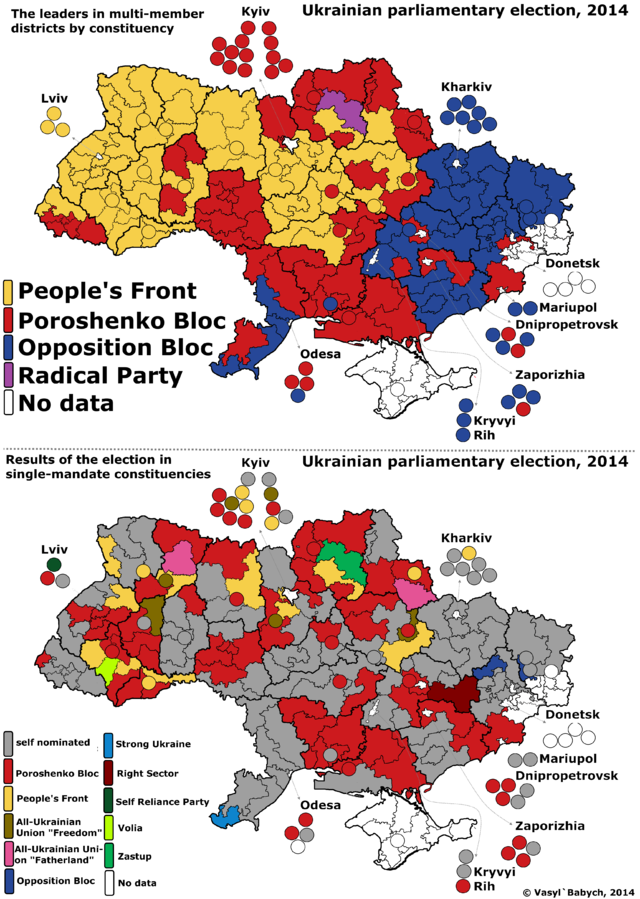
Others
| Parties/Blocs | Seats (const.) | Seats (prop.) | Total Seats |
| Freedom | 6 | 0 | 6 |
| Civil Position | 1 | 0 | 1 |
| Strong Ukraine | 1 | 0 | 1 |
| Right Sektor | 1 | 0 | 1 |
| Volia | 1 | 0 | 1 |
| Independents | 96 | 0 | 96 |
A party mainly backed by ethnic Russians won the largest number of votes in Latvia’s parliamentary elections this weekend, but is likely to be shut out of government after fears over a resurgent Kremlin dominated the campaign.
The Harmony party, led by the mayor of Riga, Nil Ushakov, won 23% of the votes in the elections, while the coalition of three current ruling parties had 56% between them.
At the last elections in 2011, the Harmony Centre Party won with 28 per cent of the vote, although it was kept out of a coalition government of ethnic Latvian parties. 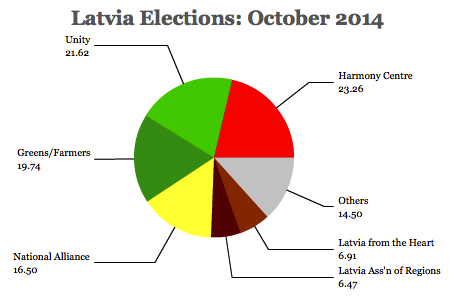
The annexation of Crimea in March has left the party in a delicate position. Many of its core supporters get their news from Russia, and as a result there is a strong pro-Moscow leaning. SKDS found that 36 per cent of the community supported Russia’s actions in Crimea. “Therefore they cannot criticise Russia even if it is obvious that Russia is supporting military actions [in Ukraine],” says Elizabete Krivcova of activist group Non-Citizens Congress, who also stood as a candidate for the Harmony Centre Party in May’s European Parliament elections.
The leftist Harmony party, allied with Russian President Vladimir Putin’s United Russia party, won only 24 of 100 seats, down from 31 in the outgoing assembly, full official results showed Sunday.
The three parties in Prime Minister Laimdota Straujuma‘s centre-right governing coalition secured a sound 61-seat majority, which could rise to 69 with a fourth party possibly joining in.
In the outgoing parliament formed after the last polls in 2011, a four-party coalition held 63 seats.
Under the constitution the new parliament will open on November 4.
Concern is running high over the impact that tit-for-tat sanctions between Moscow and Brussels over the Ukraine crisis could have on this tiny Baltic state, which is heavily reliant on trade with Russia.
Latvia made a spectacular recovery from the world’s deepest recession in 2008-09, when output shrank by nearly a quarter during the global financial crisis.
A painful austerity drive by a centre-right government then paved the way for entry into the eurozone in January.
The sacrifices paid off, and growth in Latvia topped the 28-member EU for a third consecutive year in 2013, with a 4.0 percent expansion.
“We Europeans must learn a lesson from the tragic Polish September, from the tragic years of the Second World War – tragic for all people without exception – that we cannot be naively optimistic. Today, looking at the tragedy of the Ukrainians, looking at the war – be1cause we need to use that word – we know that September 1939 cannot be allowed to be repeated” said Polish Prime Minister Donald Tusk. 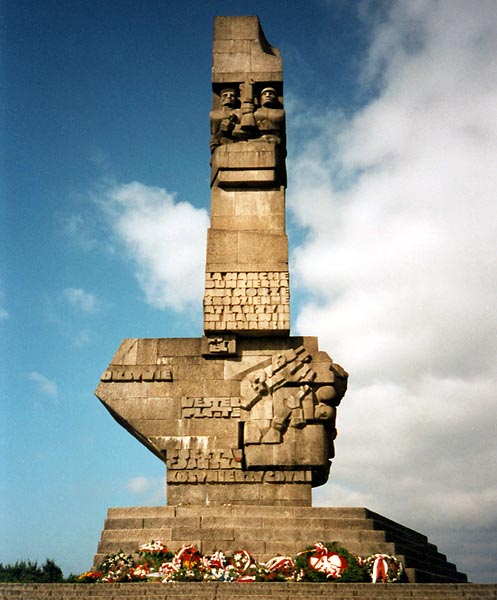
NATO member states will work towards “a new policy, whose main objective will be the security and effectiveness of our western community against the threat of war, not only in eastern Ukraine.”
It was on Gdansk’s small Westerplatte peninsula that the first shots of World War II were fired, with a small detachment of Polish soldiers attempting to withhold a siege from Nazi Germany.
Polish and German presidents Bronislaw Komorowski and Joachim Gauck met for the commemoration.
New EU appointments. The Gdansk wind.
31 Aug 2014The European Council has appointed Federica Mogherini as the next EU High Representative and Polish Prime Minister Donald Tusk as EU Council President.
Switzerland, new sanctions against Russia.
28 Aug 2014 In view of the situation in Ukraine, the Federal Council has today decided to take further measures to prevent the circumvention of international sanctions. It has amended the Ordinance of 2 April 2014 on measures to prevent the circumvention of international sanctions in relation to the situation in Ukraine to include the sanctions imposed by the EU in July. The revised ordinance enters into force at 6 pm today. 
During its discussions on the situation in Ukraine of 13 August 2014, the Federal Council decided to widen its current policy and to take all the measures required to ensure that the most recent sanctions imposed by the European Union cannot be circumvented via Swiss territory. Today the Federal Council decided on the necessary measures.
In the field of finance, issues of long term financial instruments by five Russian banks will be made subject to authorisation. In future, authorisation for new issues will only be granted if they are within the average financial engagement of the past three years. The subsidiaries of these Russian banks in Switzerland are exempt from the authorisation requirement as long as they are not acting on behalf of, or on the instructions of their parent companies. The EU’s restrictive measures also allow a similar exemption for subsidiaries of the Russian banks in question on its territory. Secondary trading in financial instruments newly issued outside Switzerland and the EU will be subject to a duty to notify. Eleven names have been added to the existing list of natural persons and businesses with whom financial intermediaries are prohibited from entering into new business relationships and whose existing business relations are subject to a duty to notify.
With regard to specific military goods and dual-use goods subject to licence, the Federal Council decided to add a further criterion for rejecting the application for an export licence to the existing list of criteria in goods control legislation. An application may now be refused if goods are intended to be used exclusively or partially for military purposes, or if they are intended for a military end user. With regard to war material, the Federal Council decided that a ban on imports of such goods from Russia and Ukraine should apply. The Federal Council also decided to introduce a duty to notify for exports of certain goods used in the extraction of oil in deep sea, Arctic or shale gas projects in Russia.
As a result of Switzerland’s decision not to recognise the annexation of Crimea by Russia constituing a breach of international law, the Federal Council has imposed a ban on imports and a ban on exports of certain key goods used in the extraction of oil and gas, as well as restrictions on investments for Crimea and Sevastopol.
The Federal Council has acknowledged the measures taken by Russia in respect of agricultural goods. It stresses that Switzerland is not engaged in any state measures to promote additional Swiss exports to Russia.
The Federal Council continues to monitor the situation in Ukraine closely and reserves the right to take further measures depending on how the situation develops.
Ukraine-related Sanctions; Publication of Executive Order 13662 Sectoral Sanctions Identifications List
7/16/2014
Today, OFAC is introducing the Sectoral Sanctions Identifications List to identify persons operating in sectors of the Russian economy identified by the Secretary of the Treasury pursuant to Executive Order 13662. Directives found within the list describe prohibitions on dealings with the persons identified.
Specially Designated Nationals List Update
In addition, the following individuals have been added to OFAC’s SDN List:
BESEDA, Sergey (a.k.a. BESEDA, Sergei; a.k.a. BESEDA, Sergei Orestovoch); DOB 1954; Commander of the Fifth Service of the FSB; Commander of the Service for Operational Information and International Communications of the FSB; FSB Colonel General; Colonel-General (individual) [UKRAINE2].
BORODAI, Aleksandr (a.k.a. BORODAI, Alexander); DOB 25 Jul 1972; nationality Russia (individual) [UKRAINE].
NEVEROV, Sergei Ivanovich (a.k.a. NEVEROV, Sergei; a.k.a. NEVEROV, Sergey); DOB 21 Dec 1961; POB Tashtagol, Russia; Deputy Chairman of the State Duma of the Russian Federation; Member of the State Duma Committee on Housing Policy and Housing and Communal Services (individual) [UKRAINE2].
SAVELYEV, Oleg Genrikhovich; DOB 27 Oct 1965; POB St. Petersburg, Russia; Minister for Crimean Affairs (individual) [UKRAINE2].
SHCHEGOLEV, Igor (a.k.a. SHCHYOGOLEV, Igor Olegovich); DOB 10 Nov 1965; POB Vinnitsa, Ukraine; alt. POB Vinnytsia, Ukraine; Aide to the President of the Russian Federation (individual) [UKRAINE2].
The following entities have been added to OFAC’s SDN List:
DONETSK PEOPLE’S REPUBLIC, Donetsk Region, Ukraine [UKRAINE].
FEDERAL STATE UNITARY ENTERPRISE STATE RESEARCH AND PRODUCTION ENTERPRISE BAZALT (a.k.a. FEDERAL STATE UNITARY ENTERPRISE, STATE RESEARCH AND PRODUCTION ENTERPRISE BAZALT; a.k.a. FSUE SRPE BAZALT; a.k.a. STATE RESEARCH AND PRODUCTION ENTERPRISE BAZALT), 32 Velyaminovskaya, Moscow 105318, Russia; Website www.bazalt.ru; Email Address moscow@bazalt.ru [UKRAINE2].
FEODOSIYA ENTERPRISE (a.k.a. FEODOSIA OIL PRODUCTS SUPPLY CO.; a.k.a. FEODOSIYA ENTERPRISE ON PROVIDING OIL PRODUCTS; a.k.a. FEODOSIYSKE COMPANY FOR THE OIL; a.k.a. THEODOSIYA OIL TERMINAL), Feodosiya, Geologicheskaya str. 2, Crimea 98107, Ukraine; Feodosia, Str. Geological 2, Crimea 98107, Ukraine [UKRAINE].
JOINT STOCK COMPANY CONCERN RADIO-ELECTRONIC TECHNOLOGIES (a.k.a. CONCERN RADIO-ELECTRONIC TECHNOLOGIES; a.k.a. “KRET”), 20/1 Korp. 1 ul. Goncharnaya, Moscow 109240, Russia; Website http://www.kret.com; Registration ID 1097746084666 [UKRAINE2].
JOINT STOCK COMPANY CONCERN SOZVEZDIE (a.k.a. JSC CONCERN SOZVEZDIE), 14 Plekhanovskaya Street, Voronezh, Russia; 14 ul. Plekhanovskaya, Voronezh, Voronezhskaya obl. 394018, Russia; Registration ID 1053600445337 [UKRAINE2].
JOINT STOCK COMPANY MILITARY-INDUSTRIAL CORPORATION NPO MASHINOSTROYENIA (a.k.a. JOINT STOCK COMPANY MILITARY INDUSTRIAL CONSORTIUM NPO MASHINOSTROYENIA; a.k.a. JSC MIC NPO MASHINOSTROYENIA; a.k.a. MIC NPO MASHINOSTROYENIA JSC; a.k.a. MIC NPO MASHINOSTROYENIYA JSC; a.k.a. MILITARY INDUSTRIAL CORPORATION NPO MASHINOSTROENIA OAO; a.k.a. OPEN JOINT STOCK COMPANY MILITARY INDUSTRIAL CORPORATION SCIENTIFIC AND PRODUCTION MACHINE BUILDING ASSOCIATION; a.k.a. VOENNO-PROMYSHLENNAYA KORPORATSIYA NAUCHNO-PROIZVODSTVENNOE OBEDINENIE MASHINOSTROENIYA OAO; a.k.a. VPK NPO MASHINOSTROENIYA), 33, Gagarina St., Reutov-town, Moscow Region 143966, Russia; 33 Gagarin Street, Reutov, Moscow Region 143966, Russia; 33 Gagarina ul., Reutov, Moskovskaya obl 143966, Russia; Website www.npomash.ru; Email Address export@npomash.ru; alt. Email Address vpk@npomash.ru; Registration ID 1075012001492 (Russia); Tax ID No. 5012039795 (Russia); Government Gazette Number 07501739 (Russia) [UKRAINE2].
JOINT-STOCK COMPANY CONCERN ALMAZ-ANTEY (a.k.a. ALMAZ-ANTEY CORP; a.k.a. ALMAZ-ANTEY DEFENSE CORPORATION; a.k.a. ALMAZ-ANTEY JSC; f.k.a. OTKRYTOE AKTSIONERNOE OBSHCHESTVO KONTSERN PVO ALMAZ ANTEI), 41 ul.Vereiskaya, Moscow 121471, Russia; Website almaz-antey.ru; Email Address antey@almaz-antey.ru [UKRAINE2].
KALASHNIKOV CONCERN (a.k.a. CONCERN KALASHNIKOV; a.k.a. IZHEVSKIY MASHINOSTROITEL’NYI ZAVOD OAO; f.k.a. IZHMASH R&D CENTER; f.k.a. JSC NPO IZHMASH; f.k.a. NPO IZHMASH OAO; a.k.a. OJSC CONCERN KALASHNIKOV; f.k.a. OJSC IZHMASH; f.k.a. SCIENTIFIC PRODUCTION ASSOCIATION IZHMASH JOINT STOCK COMPANY), 3, Derjabin Pr., Izhevsk, Udmurt Republic 426006, Russia; Registration ID 1111832003018 [UKRAINE2].
KONSTRUKTORSKOE BYURO PRIBOROSTROENIYA OTKRYTOE AKTSIONERNOE OBSHCHESTVO (a.k.a. INSTRUMENT DESIGN BUREAU; a.k.a. JSC KBP INSTRUMENT DESIGN BUREAU; a.k.a. KBP INSTRUMENT DESIGN BUREAU; a.k.a. KBP INSTRUMENT DESIGN BUREAU JOINT STOCK COMPANY; a.k.a. “KBP OAO”), 59 Shcheglovskaya Zaseka ul., Tula 300001, Russia; Website www.kbptula.ru; Email Address kbkedr@tula.net; Registration ID 1117154036911 (Russia); Government Gazette Number 07515747 (Russia) [UKRAINE2].
LUHANSK PEOPLE’S REPUBLIC (a.k.a. LUGANSK PEOPLE’S REPUBLIC; a.k.a. PEOPLE’S REPUBLIC OF LUHANSK), Luhansk Region, Ukraine [UKRAINE].
URALVAGONZAVOD (a.k.a. NAUCHNO-PROIZVODSTVENNAYA KORPORATSIYA URALVAGONZAVOD OAO; a.k.a. NPK URALVAGONZAVOD; a.k.a. NPK URALVAGONZAVOD OAO; a.k.a. OJSC RESEARCH AND PRODUCTION CORPORATION URALVAGONZAVOD; a.k.a. RESEARCH AND PRODUCTION CORPORATION URALVAGONZAVOD; a.k.a. RESEARCH AND PRODUCTION CORPORATION URALVAGONZAVOD OAO; a.k.a. URALVAGONZAVOD CORPORATION; a.k.a. “UVZ”), 28, Vostochnoye shosse, Nizhni Tagil, Sverdlovsk region 622007, Russia; 28 Vostochnoe shosse, Nizhni Tagil, Sverdlovskaya oblast 622007, Russia; 40, Bolshaya Yakimanka Street, Moscow 119049, Russia; Vistochnoye Shosse, 28, Nizhny Tagil 622007, Russia; Website http://www.uvz.ru/; alt. Website http://uralvagonzavod.com/; Email Address web@uvz.ru [UKRAINE2].
Sectoral Sanctions Identifications List Update
The following entities have been added to OFAC’s Sectoral Sanctions Identifications List:
GAZPROMBANK OAO (a.k.a. GAZPROMBANK GAS INDUSTRY OJSC; a.k.a. GAZPROMBANK OJSC; a.k.a. GAZPROMBANK OPEN JOINT STOCK COMPANY; a.k.a. GAZPROMBANK OTKRYTOE AKTSIONERNOE OBSHCHESTVO; a.k.a. GPB, OAO; a.k.a. GPB, OJSC), 16, Building 1, Nametkina St., Moscow 117420, Russia; 63, Novocheremushkinskaya St., Moscow 117418, Russia; SWIFT/BIC GAZPRUMM; Website www.gazprombank.ru; Email Address mailbox@gazprombank.ru; Registration ID 1027700167110; Tax ID No. 7744001497; Government Gazette Number 09807684 [UKRAINE-EO13662].
OAO NOVATEK (a.k.a. FINANSOVO-INVESTITSIONNAYA KOMPANIYA NOVAFININVEST OAO; a.k.a. NOVATEK), 2, Udaltsova Street, Moscow 119415, Russia; 22 A, Pobedy Street, Tarko-Sale, Yamalo-Nenets Autonomous District 629580, Russia; 22a Pobedy ul., Tarko-Sale, Purovski raion, Tyumenskaya Oblast 629850, Russia; Email Address novatek@novatek.ru; Registration ID 1026303117642 (Russia); Government Gazette Number 33556474 (Russia) [UKRAINE-EO13662].
OPEN JOINT-STOCK COMPANY ROSNEFT OIL COMPANY (a.k.a. OAO ROSNEFT OIL COMPANY; a.k.a. OIL COMPANY ROSNEFT; a.k.a. OJSC ROSNEFT OIL COMPANY; a.k.a. ROSNEFT; a.k.a. ROSNEFT OIL COMPANY), 26/1 Sofiyskaya Embankment, Moscow 115035, Russia; Website www.rosneft.com; alt. Website www.rosneft.ru; Email Address postman@rosneft.ru; Registration ID 1027700043502 (Russia); Tax ID No. 7706107510 (Russia); Government Gazette Number 00044428 (Russia) [UKRAINE-EO13662].
VNESHECONOMBANK (a.k.a. BANK FOR DEVELOPMENT AND FOREIGN ECONOMIC AFFAIRS (VNESHECONOMBANK) STATE CORPORATION; a.k.a. BANK RAZVITIYA I VNESHNEEKONOMICHESKOI DEYATELNOSTI (VNESHEKONOMBANK) GOSUDARSTVENNAYA KORPORATSIYA; a.k.a. “VEB”), 9 Akademika Sakharova prospekt, Moscow 107996, Russia; SWIFT/BIC BFEA RU MM; Website http://www.veb.ru; Email Address info@veb.ru; BIK (RU) 044525060 [UKRAINE-EO13662].
Eduard Shevardnadze, Soviet foreign minister and then president of Georgia, died on July 7th.
12 Jul 2014THE obscure provincial leader was at first sight an unlikely choice to be foreign minister of the world’s largest country. Eduard Shevardnadze did not even want the job: he spoke only his native Georgian and heavily accented Russian, had no important foreign contacts, and had barely travelled abroad. But Mikhail Gorbachev was immovable. The new Soviet leader wanted big changes—and the “Silver Fox”, his friend since the 1950s, to make them….
Article The Economist.
Ukrainian President Petro Poroshenko in Brussels signed the Association Agreement with the European Union. The signing is a milestone. Whether history records June 27 as Ukraine’s “most important day” since it regained independence in 1991—as Mr. Poroshenko suggested—remains to be seen. Much depends on implementation of the agreement. 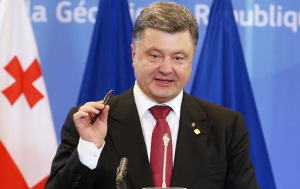
The economic pact comes months after deadly protests broke out this winter when then-Ukrainian president Viktor Yanukovych — ousted by demonstrators in February — decided not to sign the trade deal under pressure from Moscow.
Georgia and Moldova also signed association agreements with the EU in a move opposed by Russia. Georgia has already lost chunks of its territory and Black Sea coast to rebels backed by Russia after a brief war with Russia in 2008.
“There will undoubtedly be serious consequences for Ukraine and Moldova’s signing,” Grigory Karasin, Russia’s deputy foreign minister, said.
The Association Agreement can be a game-changer for Ukraine. It includes a deep and comprehensive free trade arrangement (DCFTA) that will open much of the European market to Ukrainian exports. Implementation of the agreement will not only bring Ukraine’s trade and customs rules into conformity with EU standards, it will help the country draw closer to EU democratic norms and “Europeanize” other Ukrainian regulatory regimes.
The Association Agreement lacks a membership perspective
For the European Union, signature of the association agreement with Ukraine (as well as signature of similar pacts with Georgia and Moldova) represents a significant step forward in its Eastern Partnership policy.
For the Kremlin, signature of the Ukraine-EU association agreement represents a setback. Vladimir Putin last December offered $15 billion in loans, with no overt strings attached, and a huge gas price cut to turn Ukraine away from signing.
“It’s nothing personal, but Belka should go,” Leszek Balcerowicz, a Polish finance minister between 1997 and 2000 and former central bank chief told the TVN24 news station.
Balcerowicz said that the secretly recorded conversation between Marek Belka and Interior Minister Bartlomiej Sienkiewicz, published by the Wprost magazine on Sunday, appeared to show “a violation of the neutrality of the National Bank of Poland in proposing a political deal with the ruling party”. 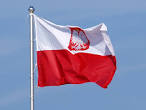
The transcripts of the recording appear to suggest that Minister Sienkiewicz asked the central bank governor to assist the government in reducing debt levels and stimulating the economy in the run up to the scheduled 2015 general election if the opposition Law and Justice (PiS) looked as if it might win the ballot.
Belka, in turn, called for the resignation of the then finance minister Jacek Rostowski, who was later sacked during a cabinet reshuffle four months after the conversation took place in a restaurant in Warsaw in July 2013.
“The central bank is an institution where good performance depends on public confidence. It takes time to build trust […] but it can be lost just as quickly,” Balcerowicz added.
PM Donald Tusk could call snap elections if a “crisis of confidence” worsens following release of illegally recorded tapes purportedly showing political collusion between central bank and government.
From Polskie Radio, PAP
Welcome
We are a group of long experienced European journalists and intellectuals interested in international politics and culture. We would like to exchange our opinion on new Europe and Russia.
Categories
- Breaking News (11)
- CIS (129)
- Climate (2)
- Energy&Economy (115)
- EU Eastern Dimension (85)
- Euro 2012 – Sochi 2014 – World Cup 2018, Sport (43)
- Euro-Integration (135)
- History Culture (198)
- International Policy (261)
- Military (74)
- Interviews (18)
- Italy – Italia – Suisse (47)
- Odd Enough (10)
- Poland and Baltic States (126)
- Religion (31)
- Russia (421)
- Survey (4)
- Turning points (4)
- Ukraine (176)
- Российские страницы (113)
Archives
- November 2020
- October 2020
- September 2020
- August 2020
- July 2020
- May 2020
- April 2020
- March 2020
- January 2020
- December 2019
- November 2019
- October 2019
- September 2019
- August 2019
- July 2019
- June 2019
- May 2019
- April 2019
- March 2019
- February 2019
- December 2018
- November 2018
- October 2018
- September 2018
- August 2018
- July 2018
- June 2018
- May 2018
- April 2018
- March 2018
- February 2018
- January 2018
- December 2017
- November 2017
- October 2017
- September 2017
- August 2017
- July 2017
- May 2017
- March 2017
- January 2017
- December 2016
- November 2016
- October 2016
- September 2016
- July 2016
- June 2016
- May 2016
- April 2016
- February 2016
- January 2016
- November 2015
- October 2015
- September 2015
- June 2015
- April 2015
- March 2015
- February 2015
- January 2015
- December 2014
- November 2014
- October 2014
- September 2014
- August 2014
- July 2014
- June 2014
- May 2014
- April 2014
- March 2014
- February 2014
- January 2014
- December 2013
- November 2013
- October 2013
- September 2013
- August 2013
- July 2013
- June 2013
- May 2013
- April 2013
- March 2013
- February 2013
- January 2013
- December 2012
- November 2012
- October 2012
- September 2012
- August 2012
- July 2012
- June 2012
- May 2012
- April 2012
- March 2012
- February 2012
- January 2012
- December 2011
- November 2011
- October 2011
- September 2011
- August 2011
- July 2011
- June 2011
- May 2011
- April 2011
- March 2011
- February 2011
- January 2011
- December 2010
- November 2010
- October 2010
- September 2010
- August 2010
- July 2010
- June 2010
- May 2010
- April 2010
- March 2010
- February 2010
- January 2010
- December 2009
- November 2009
- October 2009
- September 2009
- August 2009
Our books