Energy&Economy
Il South Stream va in archivio.
2 Dec 2014E’ stata scritta la parola fine sul progetto South Stream. La Russia ha per adesso rinunciato alla costruzione dell’avveniristico gasdotto che avrebbe portato il metano fino al cuore dell’Europa passando sotto al mar Nero ed in mezzo ai Balcani.
Troppi gli screzi con l’Unione Europea per il cosiddetto “Terzo pacchetto” dell’energia. Vladimir Putin si è arreso alla realtà ed al crollo delle quotazioni sui mercati internazionali. South Stream è per ora troppo costoso.
I riflessi economici e geopolitici sono importanti. La Saipemperde un contratto da 2 miliardi per la costruzione della tratta sottomarina; l’Eni evita di indebitarsi per rimanere dentro al consorzio. Geopoliticamente i Balcani non ottengono un futuro possibile collante per una regione da sempre instabile, l’idea di rendere l’Italia un “hub” energetico rischia di fallire con tutte le conseguenze del caso in un mondo sempre più globalizzato, la russa Gazprom rimane prigioniera dell’Ucraina.
Dopo la costruzione del Nord Stream verso la Germania la diversificazione delle vie di approvvigionamento del Vecchio Continente subisce così una pesante battuta d’arresto, aprendo la strada ad un dipendenza non più troppo marcata da Est, ma da Ovest. Il baricentro del mondo dell’energia si sposta lentamente dal Mediterraneo verso l’Atlantico, come successe ai commerci nel XVI secolo.
La conoscenza della storia avrebbe dovuto aiutare i politici italiani ad assumere le giuste posizioni.
Giuseppe D’Amato
“Due tendenze marcano l’attuale situazione energetica:
la prima è l’estensione e la drammatizzazione delle tensioni e dei conflitti nei quali l’energia appare come un parametro di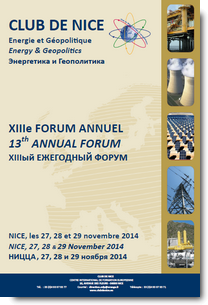 riferimento. Questo vale per il Medio Oriente, l’Ucraina, la Libia.
La seconda è l’accelerazione delle politiche di adattamento alla nuova realtà geopolitica, economica, scientifica ossia alla transizione energetica.
Quali rapporti di partenariato con la Russia? Il Mediterraneo cerca una propria collocazione: quali sono le sue aspettative ed prospettive?”
Il Club de Nice ne ha discusso per tre giorni.
Vedi anche:
Dominique Fache, Energie: du poker menteur à la roulette russe
La Russia alle prese col crollo del prezzo del petrolio ed al tramonto dei suoi futuri progetti.
RSI Audio Min. 13’50” – 17’00
Switzerland, new sanctions against Russia.
28 Aug 2014 In view of the situation in Ukraine, the Federal Council has today decided to take further measures to prevent the circumvention of international sanctions. It has amended the Ordinance of 2 April 2014 on measures to prevent the circumvention of international sanctions in relation to the situation in Ukraine to include the sanctions imposed by the EU in July. The revised ordinance enters into force at 6 pm today. 
During its discussions on the situation in Ukraine of 13 August 2014, the Federal Council decided to widen its current policy and to take all the measures required to ensure that the most recent sanctions imposed by the European Union cannot be circumvented via Swiss territory. Today the Federal Council decided on the necessary measures.
In the field of finance, issues of long term financial instruments by five Russian banks will be made subject to authorisation. In future, authorisation for new issues will only be granted if they are within the average financial engagement of the past three years. The subsidiaries of these Russian banks in Switzerland are exempt from the authorisation requirement as long as they are not acting on behalf of, or on the instructions of their parent companies. The EU’s restrictive measures also allow a similar exemption for subsidiaries of the Russian banks in question on its territory. Secondary trading in financial instruments newly issued outside Switzerland and the EU will be subject to a duty to notify. Eleven names have been added to the existing list of natural persons and businesses with whom financial intermediaries are prohibited from entering into new business relationships and whose existing business relations are subject to a duty to notify.
With regard to specific military goods and dual-use goods subject to licence, the Federal Council decided to add a further criterion for rejecting the application for an export licence to the existing list of criteria in goods control legislation. An application may now be refused if goods are intended to be used exclusively or partially for military purposes, or if they are intended for a military end user. With regard to war material, the Federal Council decided that a ban on imports of such goods from Russia and Ukraine should apply. The Federal Council also decided to introduce a duty to notify for exports of certain goods used in the extraction of oil in deep sea, Arctic or shale gas projects in Russia.
As a result of Switzerland’s decision not to recognise the annexation of Crimea by Russia constituing a breach of international law, the Federal Council has imposed a ban on imports and a ban on exports of certain key goods used in the extraction of oil and gas, as well as restrictions on investments for Crimea and Sevastopol.
The Federal Council has acknowledged the measures taken by Russia in respect of agricultural goods. It stresses that Switzerland is not engaged in any state measures to promote additional Swiss exports to Russia.
The Federal Council continues to monitor the situation in Ukraine closely and reserves the right to take further measures depending on how the situation develops.
Ukraine-related Sanctions; Publication of Executive Order 13662 Sectoral Sanctions Identifications List
7/16/2014
Today, OFAC is introducing the Sectoral Sanctions Identifications List to identify persons operating in sectors of the Russian economy identified by the Secretary of the Treasury pursuant to Executive Order 13662. Directives found within the list describe prohibitions on dealings with the persons identified.
Specially Designated Nationals List Update
In addition, the following individuals have been added to OFAC’s SDN List:
BESEDA, Sergey (a.k.a. BESEDA, Sergei; a.k.a. BESEDA, Sergei Orestovoch); DOB 1954; Commander of the Fifth Service of the FSB; Commander of the Service for Operational Information and International Communications of the FSB; FSB Colonel General; Colonel-General (individual) [UKRAINE2].
BORODAI, Aleksandr (a.k.a. BORODAI, Alexander); DOB 25 Jul 1972; nationality Russia (individual) [UKRAINE].
NEVEROV, Sergei Ivanovich (a.k.a. NEVEROV, Sergei; a.k.a. NEVEROV, Sergey); DOB 21 Dec 1961; POB Tashtagol, Russia; Deputy Chairman of the State Duma of the Russian Federation; Member of the State Duma Committee on Housing Policy and Housing and Communal Services (individual) [UKRAINE2].
SAVELYEV, Oleg Genrikhovich; DOB 27 Oct 1965; POB St. Petersburg, Russia; Minister for Crimean Affairs (individual) [UKRAINE2].
SHCHEGOLEV, Igor (a.k.a. SHCHYOGOLEV, Igor Olegovich); DOB 10 Nov 1965; POB Vinnitsa, Ukraine; alt. POB Vinnytsia, Ukraine; Aide to the President of the Russian Federation (individual) [UKRAINE2].
The following entities have been added to OFAC’s SDN List:
DONETSK PEOPLE’S REPUBLIC, Donetsk Region, Ukraine [UKRAINE].
FEDERAL STATE UNITARY ENTERPRISE STATE RESEARCH AND PRODUCTION ENTERPRISE BAZALT (a.k.a. FEDERAL STATE UNITARY ENTERPRISE, STATE RESEARCH AND PRODUCTION ENTERPRISE BAZALT; a.k.a. FSUE SRPE BAZALT; a.k.a. STATE RESEARCH AND PRODUCTION ENTERPRISE BAZALT), 32 Velyaminovskaya, Moscow 105318, Russia; Website www.bazalt.ru; Email Address moscow@bazalt.ru [UKRAINE2].
FEODOSIYA ENTERPRISE (a.k.a. FEODOSIA OIL PRODUCTS SUPPLY CO.; a.k.a. FEODOSIYA ENTERPRISE ON PROVIDING OIL PRODUCTS; a.k.a. FEODOSIYSKE COMPANY FOR THE OIL; a.k.a. THEODOSIYA OIL TERMINAL), Feodosiya, Geologicheskaya str. 2, Crimea 98107, Ukraine; Feodosia, Str. Geological 2, Crimea 98107, Ukraine [UKRAINE].
JOINT STOCK COMPANY CONCERN RADIO-ELECTRONIC TECHNOLOGIES (a.k.a. CONCERN RADIO-ELECTRONIC TECHNOLOGIES; a.k.a. “KRET”), 20/1 Korp. 1 ul. Goncharnaya, Moscow 109240, Russia; Website http://www.kret.com; Registration ID 1097746084666 [UKRAINE2].
JOINT STOCK COMPANY CONCERN SOZVEZDIE (a.k.a. JSC CONCERN SOZVEZDIE), 14 Plekhanovskaya Street, Voronezh, Russia; 14 ul. Plekhanovskaya, Voronezh, Voronezhskaya obl. 394018, Russia; Registration ID 1053600445337 [UKRAINE2].
JOINT STOCK COMPANY MILITARY-INDUSTRIAL CORPORATION NPO MASHINOSTROYENIA (a.k.a. JOINT STOCK COMPANY MILITARY INDUSTRIAL CONSORTIUM NPO MASHINOSTROYENIA; a.k.a. JSC MIC NPO MASHINOSTROYENIA; a.k.a. MIC NPO MASHINOSTROYENIA JSC; a.k.a. MIC NPO MASHINOSTROYENIYA JSC; a.k.a. MILITARY INDUSTRIAL CORPORATION NPO MASHINOSTROENIA OAO; a.k.a. OPEN JOINT STOCK COMPANY MILITARY INDUSTRIAL CORPORATION SCIENTIFIC AND PRODUCTION MACHINE BUILDING ASSOCIATION; a.k.a. VOENNO-PROMYSHLENNAYA KORPORATSIYA NAUCHNO-PROIZVODSTVENNOE OBEDINENIE MASHINOSTROENIYA OAO; a.k.a. VPK NPO MASHINOSTROENIYA), 33, Gagarina St., Reutov-town, Moscow Region 143966, Russia; 33 Gagarin Street, Reutov, Moscow Region 143966, Russia; 33 Gagarina ul., Reutov, Moskovskaya obl 143966, Russia; Website www.npomash.ru; Email Address export@npomash.ru; alt. Email Address vpk@npomash.ru; Registration ID 1075012001492 (Russia); Tax ID No. 5012039795 (Russia); Government Gazette Number 07501739 (Russia) [UKRAINE2].
JOINT-STOCK COMPANY CONCERN ALMAZ-ANTEY (a.k.a. ALMAZ-ANTEY CORP; a.k.a. ALMAZ-ANTEY DEFENSE CORPORATION; a.k.a. ALMAZ-ANTEY JSC; f.k.a. OTKRYTOE AKTSIONERNOE OBSHCHESTVO KONTSERN PVO ALMAZ ANTEI), 41 ul.Vereiskaya, Moscow 121471, Russia; Website almaz-antey.ru; Email Address antey@almaz-antey.ru [UKRAINE2].
KALASHNIKOV CONCERN (a.k.a. CONCERN KALASHNIKOV; a.k.a. IZHEVSKIY MASHINOSTROITEL’NYI ZAVOD OAO; f.k.a. IZHMASH R&D CENTER; f.k.a. JSC NPO IZHMASH; f.k.a. NPO IZHMASH OAO; a.k.a. OJSC CONCERN KALASHNIKOV; f.k.a. OJSC IZHMASH; f.k.a. SCIENTIFIC PRODUCTION ASSOCIATION IZHMASH JOINT STOCK COMPANY), 3, Derjabin Pr., Izhevsk, Udmurt Republic 426006, Russia; Registration ID 1111832003018 [UKRAINE2].
KONSTRUKTORSKOE BYURO PRIBOROSTROENIYA OTKRYTOE AKTSIONERNOE OBSHCHESTVO (a.k.a. INSTRUMENT DESIGN BUREAU; a.k.a. JSC KBP INSTRUMENT DESIGN BUREAU; a.k.a. KBP INSTRUMENT DESIGN BUREAU; a.k.a. KBP INSTRUMENT DESIGN BUREAU JOINT STOCK COMPANY; a.k.a. “KBP OAO”), 59 Shcheglovskaya Zaseka ul., Tula 300001, Russia; Website www.kbptula.ru; Email Address kbkedr@tula.net; Registration ID 1117154036911 (Russia); Government Gazette Number 07515747 (Russia) [UKRAINE2].
LUHANSK PEOPLE’S REPUBLIC (a.k.a. LUGANSK PEOPLE’S REPUBLIC; a.k.a. PEOPLE’S REPUBLIC OF LUHANSK), Luhansk Region, Ukraine [UKRAINE].
URALVAGONZAVOD (a.k.a. NAUCHNO-PROIZVODSTVENNAYA KORPORATSIYA URALVAGONZAVOD OAO; a.k.a. NPK URALVAGONZAVOD; a.k.a. NPK URALVAGONZAVOD OAO; a.k.a. OJSC RESEARCH AND PRODUCTION CORPORATION URALVAGONZAVOD; a.k.a. RESEARCH AND PRODUCTION CORPORATION URALVAGONZAVOD; a.k.a. RESEARCH AND PRODUCTION CORPORATION URALVAGONZAVOD OAO; a.k.a. URALVAGONZAVOD CORPORATION; a.k.a. “UVZ”), 28, Vostochnoye shosse, Nizhni Tagil, Sverdlovsk region 622007, Russia; 28 Vostochnoe shosse, Nizhni Tagil, Sverdlovskaya oblast 622007, Russia; 40, Bolshaya Yakimanka Street, Moscow 119049, Russia; Vistochnoye Shosse, 28, Nizhny Tagil 622007, Russia; Website http://www.uvz.ru/; alt. Website http://uralvagonzavod.com/; Email Address web@uvz.ru [UKRAINE2].
Sectoral Sanctions Identifications List Update
The following entities have been added to OFAC’s Sectoral Sanctions Identifications List:
GAZPROMBANK OAO (a.k.a. GAZPROMBANK GAS INDUSTRY OJSC; a.k.a. GAZPROMBANK OJSC; a.k.a. GAZPROMBANK OPEN JOINT STOCK COMPANY; a.k.a. GAZPROMBANK OTKRYTOE AKTSIONERNOE OBSHCHESTVO; a.k.a. GPB, OAO; a.k.a. GPB, OJSC), 16, Building 1, Nametkina St., Moscow 117420, Russia; 63, Novocheremushkinskaya St., Moscow 117418, Russia; SWIFT/BIC GAZPRUMM; Website www.gazprombank.ru; Email Address mailbox@gazprombank.ru; Registration ID 1027700167110; Tax ID No. 7744001497; Government Gazette Number 09807684 [UKRAINE-EO13662].
OAO NOVATEK (a.k.a. FINANSOVO-INVESTITSIONNAYA KOMPANIYA NOVAFININVEST OAO; a.k.a. NOVATEK), 2, Udaltsova Street, Moscow 119415, Russia; 22 A, Pobedy Street, Tarko-Sale, Yamalo-Nenets Autonomous District 629580, Russia; 22a Pobedy ul., Tarko-Sale, Purovski raion, Tyumenskaya Oblast 629850, Russia; Email Address novatek@novatek.ru; Registration ID 1026303117642 (Russia); Government Gazette Number 33556474 (Russia) [UKRAINE-EO13662].
OPEN JOINT-STOCK COMPANY ROSNEFT OIL COMPANY (a.k.a. OAO ROSNEFT OIL COMPANY; a.k.a. OIL COMPANY ROSNEFT; a.k.a. OJSC ROSNEFT OIL COMPANY; a.k.a. ROSNEFT; a.k.a. ROSNEFT OIL COMPANY), 26/1 Sofiyskaya Embankment, Moscow 115035, Russia; Website www.rosneft.com; alt. Website www.rosneft.ru; Email Address postman@rosneft.ru; Registration ID 1027700043502 (Russia); Tax ID No. 7706107510 (Russia); Government Gazette Number 00044428 (Russia) [UKRAINE-EO13662].
VNESHECONOMBANK (a.k.a. BANK FOR DEVELOPMENT AND FOREIGN ECONOMIC AFFAIRS (VNESHECONOMBANK) STATE CORPORATION; a.k.a. BANK RAZVITIYA I VNESHNEEKONOMICHESKOI DEYATELNOSTI (VNESHEKONOMBANK) GOSUDARSTVENNAYA KORPORATSIYA; a.k.a. “VEB”), 9 Akademika Sakharova prospekt, Moscow 107996, Russia; SWIFT/BIC BFEA RU MM; Website http://www.veb.ru; Email Address info@veb.ru; BIK (RU) 044525060 [UKRAINE-EO13662].
Как Россия не стала энергетической сверхдержавой
25 May 2014«Сейчас, когда идеи Ходорковского осуществлены Кремлем, правда, в карикатурном виде, самое время подумать над тем, на какой исторической развилке мы стояли 11 лет назад и какую судьбу упустили
Президент Путин подписал с Китаем контракт о поставке газа, переговоры о котором велись 10 лет. Газа при этом, собственно, еще нет, и трубопровода тоже нет. Чтобы его продать, надо будет освоить Иркутское и Чаяндинское месторождения и построить газопровод «Сила Сибири». По предварительным оценкам «Газпрома», «Сила Сибири» обойдется в 30 млрд долларов, то есть в 7,5 млн долларов за км. Впрочем, предварительные оценки имеют свойство расти: нефтепровод «Бованенково—Ухта», к примеру, в итоге обошелся «Газпрому» в 18 млн долл. за км. При этом газопровод из Туркмении обошелся Китаю по 1 млн долл. за км — 6,5 млрд долл. за 6,4 тыс. км.
Но это не то, о чем я хочу писать. Я хочу напомнить своим читателям одну из причин ареста Ходорковского. Она заключалась в том, что Михаил Ходорковский в 2003-м хотел строить трубопровод «Ангарск—Дацин». Это должен был быть совмещенный нефте- и газопровод, и он должен был быть завершен к 2005 году. Общая стоимость строительства оценивалась Ходорковским в 3—5 млрд долл. Собственно, совершенно не важно, сколько бы стоил трубопровод, потому что Ходорковский хотел строить частный трубопровод на деньги ЮКОСа… »
Статья – Юлия Латынина – Новая Газета
На первый взгляд кажется, что контракт с Пекином заключен достаточно оперативно, после обострения газовых отношений России и Украины. Однако, как рассказал «МК» источник, знакомый с ходом переговоров, поставки российского газа в Поднебесную идут уже несколько лет. «В стратегическом плане для Китая российский трубопроводный газ — это важнейший внешний канал поставки. Остальные каналы, например танкерные перевозки СПГ, уязвимы в случае ухудшения политической стабильности в Азиатско-Тихоокеанском регионе. 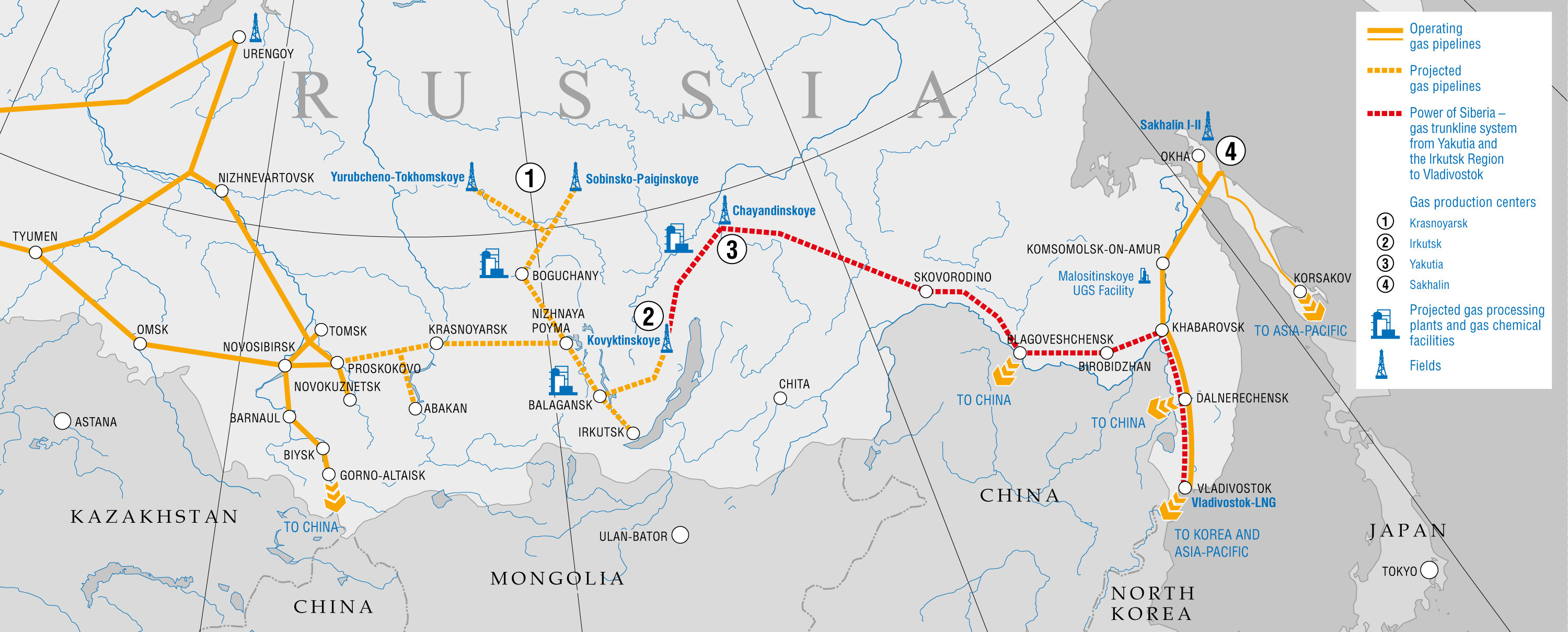
Так или иначе, в среду в Шанхае «Газпром» и китайская корпорация CNPC (ее дочернее подразделение PertroChina) подписали контракт на поставку российского газа в Китай. Речь идет о 30-летнем контракте на поставку до 38 млрд кубометров газа в год.. Россия — не единственный потенциальный экспортер «голубого топлива», о поставках с которым в последнее время договорился в Пекин. Китайские государственные корпорации владеют значительными долями в нефтегазовых компаниях Казахстана. Также поставки осуществляются из Туркмении. В декабре 2009 года заработал газопровод «Туркменистан — Узбекистан — Казахстан — Китай». Существуют и другие альтернативные варианты поставок.
У России полноценного трубопроводного соединения с Китаем пока нет. Наладить поставки можно за счет строительства нового экспортного маршрута. Проекты новых газопроводов, которые могут быть построены в течение 4-6 лет, уже существуют. Один из них — газопровод «Сила Сибири», грядущую прокладку которого Путин назвал «стройкой века» — рассчитан на максимальную мощность в 61 млрд кубометров в год. По словам главы Минэнерго России Александр Новак, этот газопровод в настоящее время считается основным потенциальным маршрутом поставок газа в Поднебесную. По мнению Владимира Путина, прогнозные доходы от реализации этого проекта станут рекордными для российской газовой монополии.
Есть еще один вариант поставок. Проектная мощность другого возможного газопровода — «Алтай» — составляет 30 млрд ежегодно, а стоимость — около $11 млрд. Впрочем, строительство этой ветки будет напрямую зависеть от сооружения «Силы Сибири». Если необходимость в строительстве «Алтая» будет подвергнута сомнению, решение о начале этого проекта будет пересмотрена.
Экономические преимущества договора с Китаем эксперты пока оценить затрудняются. Общий объем инвестиций с российской стороны для реализации контракта составит $55 млрд, с китайской — $22 млрд. Всего за 30 лет наша страна получит по этому контракту $400 млрд. Из них $25 млрд Пекин обещает предоставить «Газпрому» в качестве аванса.
В прямом пересчете на единицу объема $400 млрд за 30 лет — это около $350 за тысячу кубометров. Однако как будет меняться реальная стоимость «голубого топлива» каждый год, пока не ясно. Глава «Газпрома» Алексей Миллер утверждает, что это коммерческая тайна. Судя по всему, подписанный документ пока носит рамочный характер, а конкретный тарифный уровень будет утверждаться уже непосредственно перед началось поставок. На строительство и ввод в эксплуатацию новых газопроводов в Китай может уйти несколько лет.
Действительно, как говорит источник «МК», близкий к переговорам, пока фиксированная цена не определена. Стоимость газа привязана к цене на нефть и нефтепродукты, в этой формуле учитывается и ежегодная индексация, и инвестиционные риски, и другие тонкости переговоров.
Заключение газового договора с Китаем является прорывом в направлении развития отношений с Азией в энергетической сфере. У России появляется возможность увеличивать поставки и минимизировать затраты при экспорте на рынок, спрос на котором растет на 25% в год. Наша страна сможет развивать сопутствующие добыче «голубого топлива» отрасли, строить в Восточной Сибири и на Дальнем Востоке газохимические предприятия, заводы по сжижению газа, перевалочные комплексы. Эти проекты позволяют увеличить также и количество новых рабочих мест. Под строительство, так как проекты направлены на Китай, можно будет привлекать заемные средства в китайских кредитных организациях.
Кроме того, этот контракт дает России большую возможность для маневра в переговорах с другими зарубежными покупателями газа, главным образом, с европейскими. Россия показала, что умеет договариваться о заключении важных соглашений в самые сжатые сроки. В связи с этим, подписанное с Поднебесной в соглашение, может быть использовано в качестве инструмента давления на предстоящей встрече с представителями Евросоюза, которая состоится 26 мая и где будет обсуждаться компромиссная цена российского «голубого топлива» для Украины.
Материалы от МК России
Russia-China gas deal at last
21 May 2014China and Russia signed a widely anticipated 30-year natural gas agreement in Shanghai. This agreement will diversify both sides’ energy consumption and supply structures
The 30-year gas supply deal, worked out in Shanghai between China National Petroleum Corp (CNPC) and Russia’s state-controlled entities Gazprom, ended a decade of negotiation between the two countries. 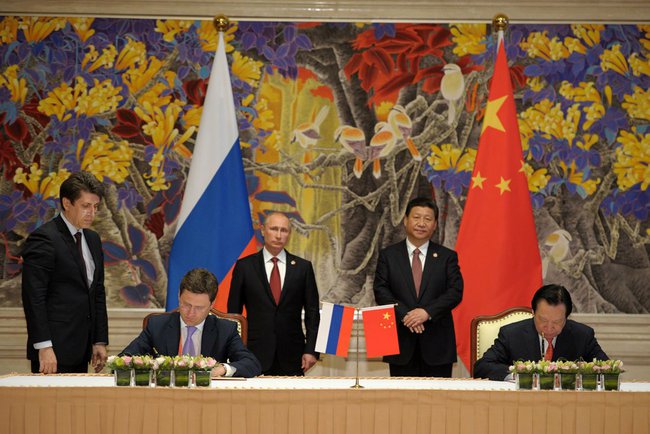
CNPC said in a statement that the imported natural gas will mainly supply regions around Beijing, cities in northeast China as well as the Yangtze River Delta.
According to the agreement, the east route pipeline will start providing China with 38 billion cubic meters of natural gas annually from 2018.
The price details have not been disclosed but earlier media reports projected the contract price could be $400 billion. It means that the final price is around 350 US dollars per thousand cubic meters.
Both countries get advantages: China will have more leverage when it negotiates with the other natural gas exporters in the future. And Russia obtains a huge, new market outside Europe.
One key point was who should pay to build the pipelines. If China can pay in advance for the imported gas, Russia will use the money to build the pipeline.
The gas from Russia accounts for only a small part of China’s overall energy consumption. Developed countries remain major trade partners for China.
China needs the gas to help it cut its coal-fired smog levels, and it wants to diversify supply. It had the luxury of time in which to negotiate, something Mr Putin was short of.
The perceived motive for the deal is that Russia needs a second market for its gas, so it can face up to European sanctions. Given that the “Power of Siberia” pipeline won’t start pumping gas into Chinese factories until 2018 at the earliest, its economic effect on the European crisis will be limited.
The EU must create an energy union to secure its gas supply because the current dependence on Russian energy makes Europe weak, Poland’s prime minister, Donald Tusk, wrote in an article in the Financial Times.
Russia, which provides around one third of the EU’s oil and gas, sent shockwaves through the international community with its military intervention and annexation of Ukraine’s Crimea peninsula in March. 
Tusk noted that the EU was creating a banking union, with a single supervisor, and a single resolution mechanism and fund to close down failing institutions.
The EU was also already jointly buying uranium for its nuclear power plants. The approach to Russian gas should be the same,.
“I therefore propose an energy union. It will return the European Community to its roots,” EU precursor the European Coal and Steel Community was formed in 1952.
Such a union should be based on several elements, he explained.
The first of these would be the creation of a single European body that would buy gas for the whole 28-nation bloc. Another would be that if one or more EU countries were threatened with being cut off from gas supplies, the others would help through “solidarity mechanisms“.
The EU must also help finance gas storage capacity and gas links in the countries most dependent on gas sold by the state-owned Russian gas monopoly Gazprom. The energy union would also seek agreements to buy gas from exporters outside Europe, such as the United States or Australia. It could be transported to Europe by ship in liquefied form.
“Today, at least 10 EU member states depend on a single supplier – Gazprom – for more than half of their consumption. Some are wholly dependent on Russia’s state-controlled gas giant,” Tusk said.
Another element was the full use of the EU’s existing fossil fuels, including coal and shale gas.
“In the EU’s eastern states, Poland among them, coal is synonymous with energy security. No nation should be forced to extract minerals but none should be prevented from doing so – as long as it is done in a sustainable way,” Tusk said.
Finally the EU should strengthen the existing Energy Community of the EU and eight of its eastern neighbours, created in 2005 to extend the European gas market eastward.
WASHINGTON – The U.S. Department of the Treasury’s Office of Foreign Assets Control (OFAC) today designated sixteen Russian government officials, members of the Russian leadership’s inner circle, including a Russian bank pursuant to Executive Order (E.O.) 13661, which was signed by President Obama on March 16, 2014. E.O. 13661 authorizes sanctions on, among others, officials of the Russian Government and any individual or entity that is owned or controlled by, that has acted for or on behalf of, or that has provided material or other support to, a senior Russian government official. 
The sixteen individuals being sanctioned as Russian government officials are: Viktor Ozerov, Vladimir Dzhabarov, Evgeni Bushmin, Nikolai Ryzhkov, Sergei Zheleznyak, Sergei Mironov, Aleksandr Totoonov, Oleg Panteleev, Sergey Naryshkin, Victor Ivanov, Igor Sergun, Sergei Ivanov, Alexei Gromov, Andrei Fursenko, Vladimir Yakunin, and Vladimir Kozhin
Those being designated for acting for or on behalf of or materially assisting, sponsoring, or providing financial, material, or technological support for, or goods or services to or in support of, a senior official of the Government of the Russian Federation are: Gennady Timchenko, Arkady Rotenberg, Boris Rotenberg, Yuri Kovalchuk and Bank Rossiya. In addition to being designated for providing material support to Russian government officials, Bank Rossiya is also being designated for being controlled by designated inner circle member Kovalchuk.
“With its currency near an all-time low, its stock market down twenty percent this year and a marked rise in interest rates, Russia has already started to bear the economic costs of its unlawful effort to undermine Ukraine’s security, stability, and sovereignty,” said Under Secretary for Terrorism and Financial Intelligence David S. Cohen. “As President Obama has made clear, we will continue to impose costs in direct response to Russia’s provocative acts, even as we have made clear there is a path to de-escalate the situation in Ukraine that respects Ukraine’s sovereignty and territorial integrity and takes account of Russia’s legitimate interests.”
Russian Government Officials and Members of the Inner Circle:
Government Officials
The following sixteen individuals are being designated because they are officials of the Russian government. Although not the basis for the designation, several are also very close advisors to senior Russian government officials.
Viktor Ozerov is the Chairman of the Security and Defense Committee of the Federation Council of the Russian Federation. On March 1, 2014, Ozerov supported Russian President Vladimir Putin’s appeal regarding the use of the Russian Armed Forces in Ukraine.
Vladimir Dzhabarov is the First Deputy Chairman of the International Affairs Committee of the Federation Council of the Russian Federation. On March 1, 2014, Dzhabarov supported the Putin’s appeal regarding the use of the Russian Armed Forces in Ukraine.
Evgeni Bushmin is the Deputy Speaker of the Federation Council of the Russian Federation. On March 1, 2014, Bushmin publicly supported the deployment of Russian forces in Ukraine.
Nikolai Ryzhkov is a Senator in the Russian Upper House of Parliament (Federation Council). Ryzhkov publicly supported the deployment of Russian forces in Ukraine.
Sergei Zheleznyak is the Deputy Speaker of the State Duma of the Russian Federation.
Sergei Mironov is a Member of the Council of the State Duma, a Member of the State Duma Committee on Housing Policy and Housing and Communal Services, and Leader of the Fair Russia Faction in the Duma of the Russian Federation.
Aleksandr Totoonov is a Member of the Committee on Culture, Science, and Information, Federation Council of the Russian Federation. On March 1, 2014, Totoonov publicly supported the deployment of Russian forces in Ukraine.
Oleg Panteleev is the First Deputy Chairman of the Committee on Parliamentary Issues. On March 1, 2014, Panteleev publicly supported the deployment of Russian forces in Ukraine.
Sergey Naryshkin has been the Chairman of the Government Duma of the Federal Gathering of the Russian Federation since December, 2011. Additionally, he is a member of the National Security Council of the Russian Federation and of the United Russia party.
Victor Ivanov has been director of the Federal Drug Control Service (FSKN) of the Russian Federation since May 15, 2008; he was appointed as a member of the Security Council of the Russian Federation on May 25, 2008. Ivanov has served in a number of other government positions prior to that; he was Assistant to the President of the Russian Federation from 2004 – 2008; and Deputy Chief of the Administration of the Russian Federation from 2000 – 2004. Ivanov joined the KGB in 1977 and eventually rose to become the Deputy Director of the Federal Security Service. Ivanov is a close ally of Putin and served alongside Putin as the chief of staff of the St. Petersburg Mayor’s office in 1994 when Putin was first deputy head of the city’s administration.
Igor Sergun is the head of Russia’s military intelligence service (GRU) and is Deputy Chief of the General Staff.
Sergei Ivanov is the Chief of Staff of the Presidential Executive Office.
Alexei Gromov is the First Deputy Chief of Staff of the Presidential Executive Office.
Andrei Fursenko is an aide to the President of the Russian Federation and has been in that position since May 21, 2012. Fursenko has held a number of positions in the Government of the Russian Federation since 2001, including Minister of Education and Science from 2004 – 2012. Although not being designated for being a member of the Russian leadership’s inner circle, Fursenko first met Putin in 1993 and they remain closely associated.
Vladimir Yakunin was appointed as chairman of the board of the Russian state-owned company Russian Railways on June 15, 2005; he has remained as head of the company ever since. Yakunin is being designated because of his official position in the Russian government, but he is also a close confidant of Putin. Yakunin regularly consults with Putin on issues regarding the Russian Railways company. In addition, Yakunin accompanies Putin on many domestic and international visits. Yakunin met Putin while both were working in St. Petersburg. Yakunin decided to create a business center in the city and contacted Putin for his support. In addition, Yakunin became a member of the board of the Baltic Maritime Steamship Company on Putin’s instructions. Yakunin and Putin were also neighbors in the elite dacha community on the shore of Lake Komsomolsk and they served as cofounders of the Ozero Dacha Cooperative in November 1996.
Vladimir Kozhin was appointed the Head of Administration under the President of the Russian Federation by Putin on January 21, 2000. He has served continuously in that position until the present time. Kohzin is responsible for overseeing a staff of 60,000, over a hundred enterprises and institutions including the Kremlin and several other government buildings, and over four thousand vehicles. Kohzin’s positions have been variously referred to as Head of Administration, Head of the Presidential Affairs Office, Head of the Presidential Business Management Directorate of the Russian Federation, and head of the Presidential Property Management Directorate.
Members of the Inner Circle
The following individuals are being designated because each is controlled by, has acted for or on behalf of, or has provided material or other support to, a senior Russian government official.
Gennady Timchenko is one of the founders of Gunvor, one of the world’s largest independent commodity trading companies involved in the oil and energy markets. Timchenko’s activities in the energy sector have been directly linked to Putin. Putin has investments in Gunvor and may have access to Gunvor funds.
Arkady Rotenberg and Boris Rotenberg have provided support to Putin’s pet projects by receiving and executing high price contracts for the Sochi Olympic Games and state-controlled Gazprom. They have made billions of dollars in contracts for Gazprom and the Sochi Winter Olympics awarded to them by Putin. Both brothers have amassed enormous amounts of wealth during the years of Putin’s rule in Russia. The Rotenberg brothers received approximately $7 billion in contracts for the Sochi Olympic Games and their personal wealth has increased by $2.5 billion in the last two years alone.
Yuri Kovalchuk is the largest single shareholder of Bank Rossiya and is also the personal banker for senior officials of the Russian Federation including Putin. Kovalchuk is a close advisor to President Putin and has been referred to as one of his “cashiers.”
The following entity is being designated because it is controlled by, has acted for or on behalf of, or has provided material or other support to, senior Russian government officials.
Bank Rossiya (ОАО АБ РОССИЯ) is the personal bank for senior officials of the Russian Federation. Bank Rossiya’s shareholders include members of Putin’s inner circle associated with the Ozero Dacha Cooperative, a housing community in which they live. Bank Rossiya is also controlled by Kovalchuk, designated today. Bank Rossiya is ranked as the 17th largest bank in Russia with assets of approximately $10 billion, and it maintains numerous correspondent relationships with banks in the United States, Europe, and elsewhere. The bank reports providing a wide range of retail and corporate services, many of which relate to the oil, gas, and energy sectors.
As a result of Treasury’s action, any assets of the persons designated today that are within U.S. jurisdiction must be frozen. Additionally, transactions by U.S. persons or within the United States involving the individuals and entity designated today are generally prohibited.
Identifying Information
Name: Viktor Alekseevich Ozerov
DOB: January 5, 1958
POB: Abakan, Khakassia, Russia
Title: Chairman of the Security and Defense Committee of the Federation Council of the Russian Federation
Name: Vladimir Michailovich Dzhabarov
AKA: Vladimir Dzhabarov
DOB: September 29, 1952
Title: First Deputy Chairman of the International Affairs Committee of the Federation Council of the Russian Federation
Name: Evgeni Viktorovich Bushmin
AKA: Evgeny Bushmin
AKA: Yevgeny Bushmin
DOB: October 10, 1958
POB: Lopatino, Sergachiisky Region, Russia
Title: Deputy Speaker of the Federation Council of the Russian Federation
Name: Nikolai Ivanovich Ryzhkov
AKA: Nikolai Ryzhkov
DOB: September 28, 1929
POB: Duleevka, Donetsk Region, Ukraine
Title: Member of the Committee for Federal Issues, Regional Politics and the North of the Federation Council of the Russian Federation
Title: Senator in the Russian Upper House of Parliament
Name: Sergei Vladimirovich Zheleznyak
AKA: Sergei Zheleznyak
AKA: Sergey Zheleznyak
DOB: July 30, 1970
POB: Saint Petersburg, Russia
Title: Deputy Speaker of the State Duma of the Russian Federation
Name: Sergei Mikhailovich Mironov
AKA: Sergei Mironov
DOB: February 14, 1953
POB: Pushkin, Saint Petersburg, Russia
Title: Member of the Council of the State Duma, Member of the State Duma Committee on Housing Policy and Housing and Communal Services, and Leader of the Fair Russia Faction in the Duma of the Russian Federation
Name: Aleksandr Borisovich Totoonov
AKA: Alexander B. Totoonov
AKA: Alexander Totoonov
DOB: March 3, 1957
POB: Ordzhonikidze, North Ossetia, Russia
POB: Vladikavkaz, North Ossetia, Russia
Title: Member of the Committee on Culture, Science, and Information, Federation Council of the Russian Federation
Name: Oleg Evgenevich Panteleev
AKA: Oleg Panteleev
DOB: July 21, 1952
POB: Zhitnikovskoe, Kurgan Region, Russia
Title: First Deputy Chairman of the Committee on Parliamentary Issues
Name: Sergey Yevgenyevich Naryshkin
AKA: Sergei Naryshkin
DOB: October 27, 1954
POB: Saint Petersburg, Russia
Name: Victor Petrovich Ivanov
AKA: Viktor Ivanov
DOB: May 12, 1950
alt. DOB: 1952
POB: Novgorod, Russia
Name: Igor Dmitrievich Sergun
DOB: March 28, 1957
Title: Lieutenant General; Chief of the Main Directorate of the General Staff (GRU), Deputy
Chief of the General Staff
Name: Sergei Ivanov
AKA: Sergey Ivanov
DOB: January 31, 1953
POB: Saint Petersburg, Russia
Title: Chief of Staff of the Presidential Executive Office
Name: Alexei Gromov
DOB: 1960
POB: Zagorsk (Sergiev, Posad), Moscow Region, Russia
Title: First Deputy Chief of Staff of the Presidential Executive Office
Title: Presidential Administration Deputy Chief of Staff
Title: First Deputy Presidential Chief of Staff
Name: Andrei Alexandrovich Fursenko
AKA: Andrei Fursenko
AKA: Andrey Fursenko
DOB: July 17, 1949
POB: Saint Petersburg, Russia
Title: Aide to the President of the Russian Federation
Name: Vladimir Ivanovich Yakunin
DOB: June 30, 1948
POB: Zakharovo Village, Gus-Khrustalnyy Rayon, Vladimir Oblast, Russia
alt. POB: Melenki, Vladimir Oblast, Russia
Name: Vladimir Igorevich Kozhin
DOB: February 28, 1959
POB: Troitsk, Chelyabinsk Oblast, Russia
Name: Gennady Timchenko
AKA: Gennadiy Nikolayevich Timchenko
AKA: Gennady Nikolayevich Timchenko
AKA: Guennadi Timtchenko
Address: Geneva, Switzerland
DOB: November 9, 1952
POB: Leninakan, Armenia
alt. POB: Gyumri, Armenia
Nationality: Finland, Russia, Armenia
Name: Arkady Rotenberg
DOB: December 15, 1951
POB: Saint Petersburg, Russia
Name: Boris Rotenberg
DOB: January 3, 1957
POB: Saint Petersburg Russia
Name: Yuri Valentinovich Kovalchuk
AKA: Yury Valentinovich Kovalchuk
DOB: July 25, 1951
POB: Saint Petersburg, Russia
Name: Bank Rossiya
FKA: Aktsionerny BANK Russian Federation
Address: 2 Liter A Pl. Rastrelli, Saint Petersbrug, 191124, Russia
E-mail: bank@abr.ru
Web Site: www.abr.ru
SWIFT/BIC: ROSY RU 2P
A dieci anni dalla “Rivoluzione delle rose” la Georgia volta pagina: finisce l’era Saakashvili. Il Paese caucasico diventa contemporaneamente una repubblica parlamentare per l’entrata in vigore della riforma costituzionale del 2010. 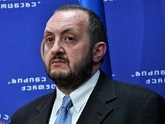
23 erano i candidati in lizza, ma di questi soltanto tre avevano vere chance. Ossia il filosofo 44enne Georgy Margvelashvili (rappresentante della coalizione Sogno georgiano ora al potere), l’ex speaker del Parlamento Nino Burjanadze (la “dama di ferro” della Rivoluzione delle rose del 2003 poi avversaria del capo di Stato uscente), il 41enne diplomatico David Bakradze (membro del Movimento Unito Nazionale di Saakashvili).
Ha vinto Margvelashvili con oltre il 62% delle preferenze, secondo è arrivato Bakradze con il 21, quindi la Burjanadze con un po’ più del 9% dei voti.
In campagna elettorale tutti i principali candidati avevano ribadito il corso di integrazione europea e nelle strutture dell’Alleanza atlantica intrapreso dal Paese caucasico, che, nell’agosto 2008, ha combattuto una disastrosa guerra contro la Russia in Ossezia meridionale.
“Maggioranza ed opposizione – ha sottolineato Margvelashvili – sono d’accordo sulla direzione fondamentale del nostro sviluppo e sugli obiettivi della nostra politica esterna nazionale”.
Il che potrebbe significare la firma del Patto di Associazione con l’Unione europea già il prossimo 28 novembre a Vilnius.
La Burjanadze è stata l’unica a mostrarsi più dubbiosa sull’integrazione nella Nato. “Fino a che vi saranno truppe russe sul nostro territorio – ha evidenziato l’ex speaker del Parlamento – ci sono poche possibilità di aderire all’Alleanza. Non ci sono stati passi politici effettivi per negoziare con Mosca”.
La Georgia è però un crocevia strategico fondamentale tra il mar Caspio ed i ricchi mercati occidentali. Da qui passano le principali pipeline tra Asia ed Europa. Ecco spiegata la grande attenzione prestata dalla comunità internazionale a queste elezioni.
Avendo già svolto due mandati presidenziali, il giovane carismatico leader georgiano, Michail Saakashvili, non ha potuto partecipare alla consultazione.
Con lui uscirà dalla vita politica attiva anche il suo principale avversario, l’attuale premier Bidzina Ivanishvili, che ha già annunciato le dimissioni per aver raggiunto i suoi obiettivi. Questo miliardario è infatti sceso in politica solo per dare al suo Paese un’alternativa al controverso Saakashvili, che ha dominato la scena nazionale dal 2003 con la Rivoluzione delle Rose, con cui di fatto spodestò dalla presidenza Eduard Shevardnadze, l’ex ministro degli Esteri di Gorbaciov.
Lo scorso anno ad ottobre il suo partito Sogno georgiano ha nettamente vinto le parlamentari, sconfiggendo duramente il movimento di Saakashvili.
“Per la prima volta – ha detto al suo seggio Ivanishvili – un candidato della compagine al potere non usa risorse amministrative per la sua campagna elettorale. Queste sono le prime elezioni di stampo europeo”.
Dopo l’uscita dei due grandi avversari la Georgia comunque cambierà. Entrerà in vigore la riforma costituzionale che la fa diventare una repubblica parlamentare. Il presidente rimarrà formalmente il capo dello Stato, manterrà ampio spazio decisionale nella politica estera, ma il governo ed il primo ministro acquisiranno maggiori poteri rispetto al passato.
Welcome
We are a group of long experienced European journalists and intellectuals interested in international politics and culture. We would like to exchange our opinion on new Europe and Russia.
Categories
- Breaking News (11)
- CIS (129)
- Climate (2)
- Energy&Economy (115)
- EU Eastern Dimension (85)
- Euro 2012 – Sochi 2014 – World Cup 2018, Sport (43)
- Euro-Integration (135)
- History Culture (198)
- International Policy (261)
- Military (74)
- Interviews (18)
- Italy – Italia – Suisse (47)
- Odd Enough (10)
- Poland and Baltic States (126)
- Religion (31)
- Russia (421)
- Survey (4)
- Turning points (4)
- Ukraine (176)
- Российские страницы (113)
Archives
- November 2020
- October 2020
- September 2020
- August 2020
- July 2020
- May 2020
- April 2020
- March 2020
- January 2020
- December 2019
- November 2019
- October 2019
- September 2019
- August 2019
- July 2019
- June 2019
- May 2019
- April 2019
- March 2019
- February 2019
- December 2018
- November 2018
- October 2018
- September 2018
- August 2018
- July 2018
- June 2018
- May 2018
- April 2018
- March 2018
- February 2018
- January 2018
- December 2017
- November 2017
- October 2017
- September 2017
- August 2017
- July 2017
- May 2017
- March 2017
- January 2017
- December 2016
- November 2016
- October 2016
- September 2016
- July 2016
- June 2016
- May 2016
- April 2016
- February 2016
- January 2016
- November 2015
- October 2015
- September 2015
- June 2015
- April 2015
- March 2015
- February 2015
- January 2015
- December 2014
- November 2014
- October 2014
- September 2014
- August 2014
- July 2014
- June 2014
- May 2014
- April 2014
- March 2014
- February 2014
- January 2014
- December 2013
- November 2013
- October 2013
- September 2013
- August 2013
- July 2013
- June 2013
- May 2013
- April 2013
- March 2013
- February 2013
- January 2013
- December 2012
- November 2012
- October 2012
- September 2012
- August 2012
- July 2012
- June 2012
- May 2012
- April 2012
- March 2012
- February 2012
- January 2012
- December 2011
- November 2011
- October 2011
- September 2011
- August 2011
- July 2011
- June 2011
- May 2011
- April 2011
- March 2011
- February 2011
- January 2011
- December 2010
- November 2010
- October 2010
- September 2010
- August 2010
- July 2010
- June 2010
- May 2010
- April 2010
- March 2010
- February 2010
- January 2010
- December 2009
- November 2009
- October 2009
- September 2009
- August 2009
Our books